Code Coverage and Randoop
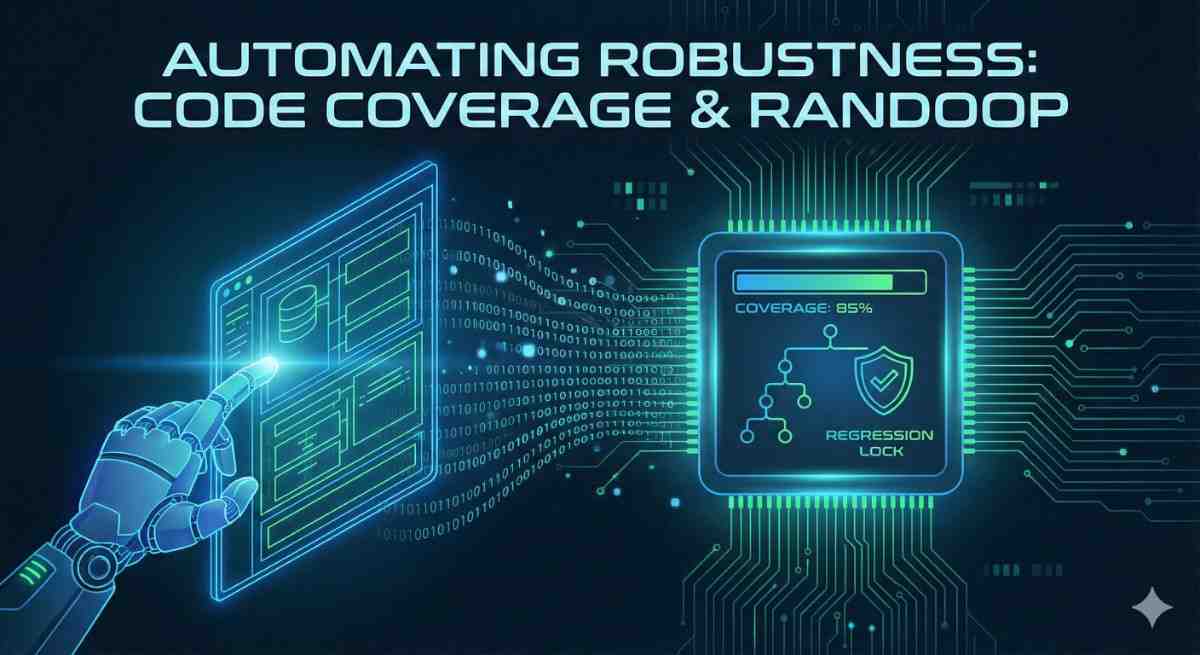
In modern software engineering, ensuring reliability goes beyond writing happy-path unit tests. As logic complexity increases, manual testing becomes insufficient for catching edge cases and state-dependent errors. This is where the synthesis of quantitative metrics (Code Coverage) and automated test generation (Randoop) becomes critical.
This post explores the technical mechanics of these practices and how they function as a safety net for regression and logical validity.
1. The Metric: Code Coverage
Code coverage is a quantitative measure used to describe the degree to which the source code of a program is executed when a particular test suite runs. It is not merely a “completion score” but a diagnostic tool for identifying untested logical paths.
While there are several types of coverage, two are particularly relevant for unit testing:
- Statement (Line) Coverage: The ratio of executed code lines to total code lines. This is the most basic metric.
- Branch Coverage: A more rigorous metric that tracks the execution of control flow branches. For every control structure (e.g.,
if,switch,while), branch coverage ensures that both thetrueandfalsepaths have been evaluated.
The Technical Caveat: High code coverage is a necessary condition for quality, but it is not sufficient. A suite can achieve 100% statement coverage but still fail to assert the correctness of the output. Therefore, coverage should be viewed as a method to identify blind spots—segments of code completely unverified by the current suite.
2. The Tool: Randoop (Feedback-Directed Random Testing)
Writing unit tests to achieve high branch coverage is often tedious and prone to human bias (developers tend to test for expected inputs). Randoop (Random Tester for Object-Oriented Programs) addresses this by automatically generating unit tests for Java classes.
Unlike simple “fuzzing” or random input generation, Randoop uses feedback-directed random testing.
How Randoop Works
- Sequence Generation: It builds sequences of method and constructor invocations incrementally.
- Execution & Filtering: After creating a sequence, it executes it.
- If the sequence crashes the runtime (e.g., illegal arguments), it is discarded.
- If the sequence creates a valid object state, it is extended with more method calls.
- Assertion Generation: It observes the return values and state changes, automatically generating JUnit assertions (
assertEquals,assertTrue) to capture the behavior.
The Two Outputs of Randoop
Randoop categorizes its generated tests into two distinct types:
A. Regression Tests These tests characterize the current behavior of the code, regardless of whether that behavior is correct.
- Purpose: To detect deviations during refactoring. If a method returns
Xtoday andYtomorrow, the regression test fails, alerting the developer to a change in logic.
B. Error-Revealing Tests These tests identify sequences that cause the code to violate specific contracts.
- Common Violations:
NullPointerExceptions, assertion failures, or violations of theObject.equals()andhashCode()contracts. - Value: These effectively act as a “smoke test” for robustness, finding inputs that cause unhandled exceptions.
3. The Workflow: Synergy Between Coverage and Generation
The most effective way to utilize these tools is in a cyclic workflow:
- Measure Coverage: Run existing manual tests to identify low-coverage classes.
- Generate Tests: targeted execution of Randoop on those specific classes (using parameters to define time limits or output limits).
- Analyze Failures:
- If Randoop finds an Error-Revealing test, there is likely a bug in the implementation or a missing check for edge cases.
- If Randoop generates Regression tests, they can be integrated into the suite to prevent future regressions.
- Refine: Once the immediate errors are fixed, the developer can refactor the code with the confidence provided by the expanded test suite.
Technical Deep Dive: Code Examples
To understand these concepts, let’s look at a simple Java class that performs a basic math operation but contains a potential “bug” and some logic branches.
1. The Subject Code
Consider this simple class MathProcessor. It has one method with an if/else structure and a hidden edge case that causes a crash.
1
2
3
4
5
6
7
8
9
10
11
12
13
14
public class MathProcessor {

    /**
     * Divides 100 by the input number, but has special logic for input 10.
     */
    public int processInput(int number) {
        if (number == 10) {
            return 0; // Special case
        }

        // Potential Bug: If number is 0, this throws ArithmeticException
        return 100 / number;
    }
}
2. Visualizing Code Coverage
Code coverage tools analyze which lines are hit during testing.
The Manual Test (Low Coverage) Imagine a developer writes one manual test for the “happy path”:
1
2
3
4
5
6
@Test
public void testStandardInput() {
    MathProcessor processor = new MathProcessor();
    int result = processor.processInput(50); // 100 / 50 = 2
    assertEquals(2, result);
}
Coverage Analysis:
- Line Coverage: The test executes
if (number == 10)(evaluates false) andreturn 100 / number. It misses thereturn 0line inside the if-block. Coverage is roughly 66%. - Branch Coverage: The test checks the
falseside of the if-statement but never checks thetrueside (where number is 10). Branch coverage is 50%.
The Danger: The code looks tested, but the special logic for 10 is never verified, and the crash for input 0 is completely undiscovered.
3. Enter Randoop: Automated Test Generation
Randoop analyzes the compiled class and generates two types of tests automatically.
A. Regression Tests (Locking in Behavior)
Randoop randomly tries inputs like 10, -5, or 100. It records the output to ensure the code doesn’t change unexpectedly in the future.
Example of a Randoop-generated Regression Test:
1
2
3
4
5
6
7
8
9
10
11
@Test
public void testRegression01() {
    // Randoop sets up the object
    MathProcessor processor = new MathProcessor();

    // Randoop tries the input 10 (which we missed in manual testing)
    int result = processor.processInput(10);

    // Randoop asserts the CURRENT behavior matches the output
    org.junit.Assert.assertEquals(0, result);
}
Why this matters: This test automatically increases our Branch Coverage to 100% because it hit the true side of the if-statement.
B. Error-Revealing Tests (Finding Bugs)
Randoop is excellent at finding “corner cases” like null, 0, or boundary values. In our example, it eventually tries 0.
Example of a Randoop-generated Error Test:
1
2
3
4
5
6
7
8
9
10
@Test
public void testError01() {
    MathProcessor processor = new MathProcessor();

    // Randoop inputs '0' and realizes the code crashes
    // It flags this as a failure because the exception was unhandled
    processor.processInput(0);

    // Result: java.lang.ArithmeticException: / by zero
}
Why this matters: Randoop found a critical bug (divide by zero) that the human developer completely forgot to consider. It creates a test case that fails, forcing the developer to fix the code (e.g., by adding a check if (number == 0)).
Summary
Manual testing relies on the developer’s foresight; automated generation relies on computational exhaustion. By combining the oversight of Code Coverage metrics with the brute-force capability of Randoop, developers can shift their focus from writing boilerplate assertions to analyzing complex logic and architectural design.