Model Transformation and Code Generation
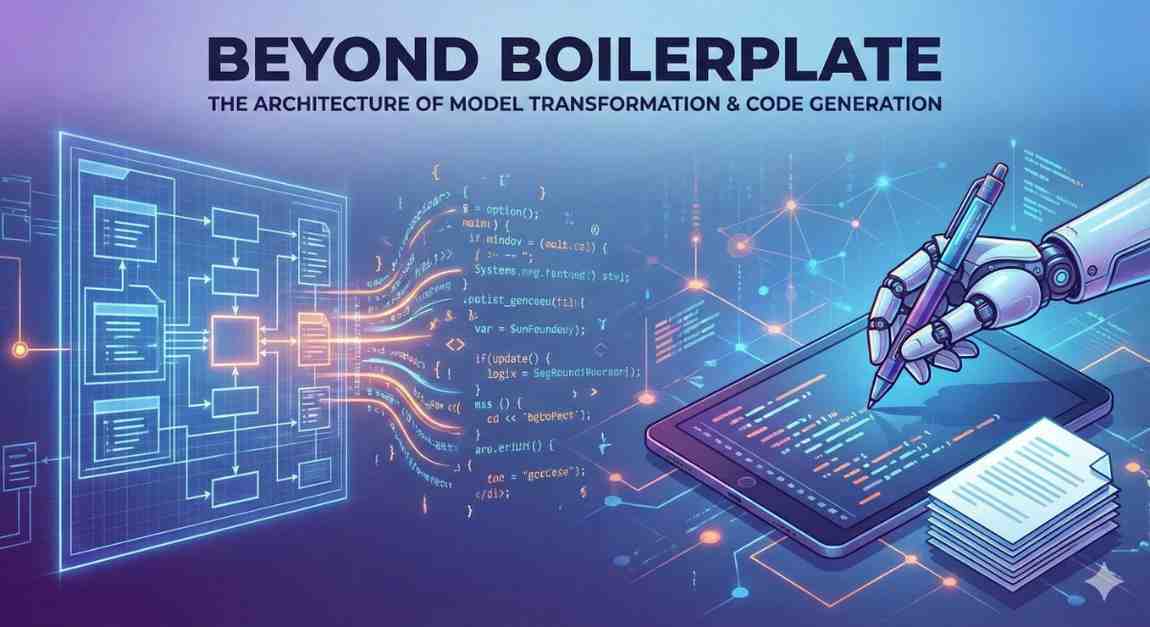
In modern software engineering, we often find ourselves repeating the same patterns: setting up CRUD endpoints, defining database schemas, or writing serialization logic. As engineers, our instinct should always be to automate. However, true automation isn’t just about writing scripts; it is about Model-Driven Development (MDD).
After reviewing some recent lecture notes on Automated Software Engineering, I want to break down the architectural principles behind Code Generation and Model Transformation. If you are building complex systems, understanding these flows is critical for maintaining consistency, reducing human error, and scaling your development velocity.
The Core Concept: Moving Up the Abstraction Ladder
The fundamental motivation for code generation is simple: Do not write code that a machine can write better.
In a typical development cycle, we work with “models” whether we realize it or not. A UML diagram, a database schema, or even a whiteboard sketch are all models—abstract representations of a system. The goal of automated engineering is to formalize these models and build a pipeline that transforms them into the final artifacts (source code, documentation, or configuration files).
This process generally happens in two distinct stages:
1. Model-to-Model Transformation (M2M)
This is the refinement stage. You might start with a high-level, domain-specific model (e.g., a business process for an e-commerce checkout) and transform it into a lower-level architectural model (e.g., a set of Java classes and SQL tables). The data hasn’t become text yet; it has just become a more detailed data structure.
- Hypothetical Scenario: Imagine modeling a Cloud Infrastructure.
- Source Model: A generic topology showing “Web Server” connected to “Database.”
- Target Model: A concrete provider-specific model where “Web Server” becomes an “AWS EC2 Instance” with security groups, and “Database” becomes an “RDS Instance.”
2. Model-to-Text Transformation (M2T)
This is the generation stage. The refined model is traversed to produce textual artifacts. This could be Java source code, XML configuration, HTML reports, or Python scripts.
- Scenario Continuation: The generator takes the “AWS EC2” object from the previous step and writes out the actual Terraform (
.tf) configuration files required to provision it.
Architectural Decisions: Generators vs. Interpreters
One key insight from the material was the distinction between generating code and interpreting models. They solve similar problems but have different performance and lifecycle profiles.
Code Generators
- Workflow:
You design the model → Generate Code → Compile → Run. - Pros: The resulting artifact is standard code. It is fast at runtime because it can be pre-optimized. It has no runtime dependencies on the modeling tool.
- Cons: The “edit-compile-run” loop is slower. If you change the model, you must regenerate the code.
Dynamic Interpreters
- Workflow:
You design the model → The engine executes the model directly at runtime. - Pros: Instant feedback. You can often change the model while the system is running.
- Cons: Performance overhead. The system constantly burns resources “reading” the model rather than just executing raw instructions. It creates a strict runtime dependency on the interpreter engine.
My Take: For security-critical or high-performance systems (like embedded devices or high-frequency trading), code generation is usually superior because it produces auditable, optimized, and standalone artifacts.
Strategies for Code Generation
If you decide to build a generator, how do you actually output the text? There are three distinct evolution levels.
1. The “Ad-Hoc” Approach (Dedicated)
This is the “quick and dirty” script. You write a program that uses print statements to output strings to a file.
- Example: A Python script iterating through a list of servers and doing
file.write("Server IP: " + ip). - Verdict: Avoid this for large projects. It mixes logic and presentation, has zero reusability, and is a nightmare to maintain. It is efficient but brittle.
2. The Template-Based Approach
This is the industry standard (similar to how web backends use Jinja2 or Razor). You have a static template file with placeholders and control logic (loops/conditionals).
- Mechanism: A template engine combines the Model (data) with the Template (structure) to produce the Artifact.
- Verdict: Excellent balance. It separates the “what” (the model) from the “how” (the syntax). You can change the target language (e.g., switch from Java to C#) just by swapping templates without touching the generator logic.
3. The Serializer/AST Approach
Instead of generating text directly, you generate a Document Object Model (DOM) or Abstract Syntax Tree (AST) and let a serializer handle the text output.
- Why do this? String manipulation is error-prone. It is easy to miss a closing brace
}or mess up imports. If you build an AST, the serializer guarantees syntactically correct code, handles generic type imports, and manages escaping automatically.
The “Overwrite” Problem: Integrating Manual Code
The single biggest pain point in code generation is the lifecycle of manual changes.
- Scenario: You generate a class. You add a custom method to it. You change the model and regenerate. Poof. Your custom method is deleted.
How do we solve this? The Generation Gap Pattern.
The Solution: Inheritance
Do not modify the generated file. Instead, make the generated class abstract (or a base class) and inherit from it.
BaseRepository.java(Generated): Contains all the boilerplate CRUD methods derived from the model. This file is overwritten every time you regenerate.Repository.java(Manual): ExtendsBaseRepository. You write your custom, complex business logic here. This file is generated once and never overwritten. This creates a clean separation of concerns. The machine owns the plumbing; you own the intelligence.
Best Practices for Advanced Text Generation
To wrap up, here are a few advanced tips I derived from the lecture material for keeping your generators sane:
- Don’t Format in the Template: Templates are ugly. They are full of loop logic and interpolation tags. Trying to manage indentation and whitespace inside the template is a losing battle.
- Tip: Generate “ugly” but syntactically correct code, and then run a standard code formatter (like Prettier or Eclipse JDT) as a post-processing step.
Separate the Generator Model: Sometimes the input model isn’t enough. You need extra parameters (e.g., “Target Directory,” “Copyright Header,” “Debug Mode”). Encapsulate these in a separate “Generator Model” that guides the process, ensuring your domain model remains pure.
Sanitize Inputs: If your model allows a user to name an entity
class, and you generate Java code, you will break the build becauseclassis a reserved keyword. Your generator must validate or escape keywords before generation (e.g., convertingclasstoclazzor_class).
Conclusion
Code generation is not about being lazy; it is about formalizing knowledge. When you move logic from “hand-written” to “generated,” you are effectively stating that you understand that domain well enough to automate it. Whether you are using templates (like Xtend or Velocity) or building ASTs, the goal remains the same: efficient, consistent, and error-free software delivery.
Acknowledgment: Based on my interpretation of the lecture notes: “Automated Software Engineering - Model Transformation and Code Generation”.