Object-Oriented Design Patterns
As software engineers and security researchers, we often encounter the same recurring structural problems:
- How do we manage object lifecycles securely?
- How do we decouple implementations to allow for safe testing?
- How do we manage state transitions without creating spaghetti code?
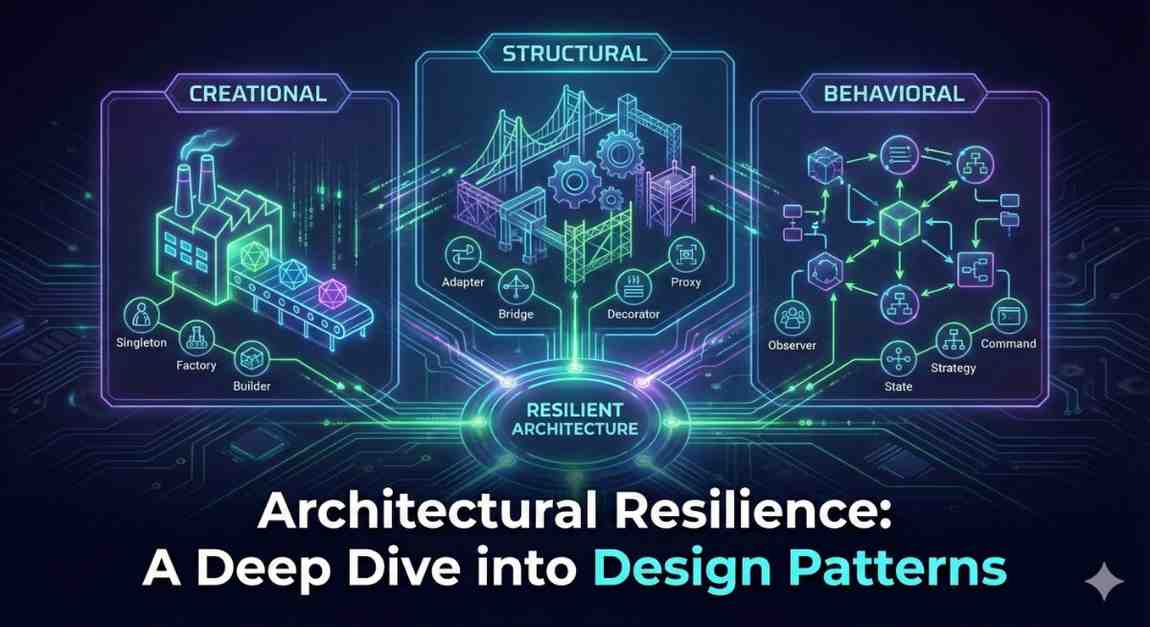
The answer often lies in Design Patterns. These are not just “best practices”; they are battle-tested blueprints for solving architectural problems. Based on my recent analysis of object-oriented design principles, I want to break down the three major categories of patterns—Creational, Structural, and Behavioral—and demonstrate how they can be applied to build robust, scalable, and secure systems.
1. Creational Patterns
Creational patterns abstract the instantiation process. They help make a system independent of how its objects are created, composed, and represented, which is critical when we need to strictly control object lifecycles or manage dependencies in complex environments.
Singleton
The Singleton ensures a class has only one instance and provides a global point of access to it. While often debated, it is essential for resources that must have a single source of truth, such as a centralized security configuration manager.
- Scenario: A
SecurityContextthat loads firewall rules. You cannot have multiple instances conflicting on which rules are active. - Pros: strict control over the instance, lazy initialization.
Cons: difficult to unit test and implement correctly in multi-threaded environments.
1
2
3
4
5
6
7
8
9
10
11
12
13
14
15
16
17
18
19
20
21
22
23
24
25
26
27
28
29
30
31
32
33
34
35
36
37
38
39
40
41
42
43
44
45
46
47
48
49
50
51
52
53
54
using System;

public sealed class DatabaseConnection
{
    // 1. Private static variable to hold the single global instance
    private static DatabaseConnection _instance;

    // 2. Private constructor prevents instantiation from other classes
    private DatabaseConnection(string connectionString)
    {
        this.ConnectionString = connectionString;
    }

    public string ConnectionString { get; private set; }

    // 3. Public static accessor (Global Access Point) with Lazy Initialization
    public static DatabaseConnection Instance
    {
        get
        {
            // Check if the instance exists; if not, create it.
            //
            if (_instance == null)
            {
                _instance = new DatabaseConnection("Server=myServer;Database=myDB;");
            }
            return _instance;
        }
    }

    // Example business method
    public void ExecuteQuery(string query)
    {
        Console.WriteLine($"Executing query '{query}' on {this.ConnectionString}");
    }
}

// Client Usage
public class Program
{
    public static void Main()
    {
        // Access the single instance
        var db = DatabaseConnection.Instance;

        db.ExecuteQuery("SELECT * FROM Users");

        // Verify it is the same instance
        var db2 = DatabaseConnection.Instance;
        Console.WriteLine(ReferenceEquals(db, db2)); // Output: True
    }
}
Factory Method (Virtual Constructor)
This pattern defines an interface for creating an object but lets subclasses alter the type of objects that will be created.
- Scenario: A
ReportGeneratorabstract class. Subclasses likePdfReportGeneratororHtmlReportGeneratordecide which concrete object to instantiate. Benefit: The client code (the reporting service) doesn’t need to know the specific class of the report it’s generating, adhering to the Open-Closed Principle (OCP).
Interface
1
2
3
4
  public interface IReport
  {
      void Render();
  }
Concrete Products
1
2
3
4
5
6
7
8
9
  public class PdfReport : IReport
  {
      public void Render() => Console.WriteLine("Rendering PDF report...");
  }

  public class HtmlReport : IReport
  {
      public void Render() => Console.WriteLine("Rendering HTML report...");
  }
Abstract Creator - Factory Method
1
2
3
4
5
6
7
8
9
10
11
12
  public abstract class ReportGenerator
  {
      // Factory Method — subclasses override this
      protected abstract IReport CreateReport();

      // Template method using the factory method
      public void Generate()
      {
          var report = CreateReport();  // creation delegated to subclass
          report.Render();
      }
  }
Concrete creators
1
2
3
4
5
6
7
8
9
  public class PdfReportGenerator : ReportGenerator
  {
      protected override IReport CreateReport() => new PdfReport();
  }

  public class HtmlReportGenerator : ReportGenerator
  {
      protected override IReport CreateReport() => new HtmlReport();
  }
Client Code
1
2
3
4
5
6
7
  public class ReportingService
  {
      public void Run(ReportGenerator generator)
      {
          generator.Generate();  // works with ANY report type
      }
  }
Abstract Factory
This interface creates families of related or dependent objects without specifying their concrete classes.
- Scenario: A cross-platform UI toolkit. A
WidgetFactoryinterface could have implementations likeMacOSFactoryandWindowsFactory. TheMacOSFactoryensures that when you ask for a button and a scrollbar, they match visually (both are MacOS style).
Builder
The Builder separates the construction of a complex object from its representation. This is ideal when an object requires many configuration steps before it is valid.
- Scenario: An
HttpRequestBuilder. You might need to set headers, the body, the method, and timeout settings step-by-step before finally building the request object. Key Difference: Unlike factories which create objects in one go, the Builder constructs them step-by-step.
1
2
3
4
5
6
7
8
  // Hard to read: Is "5000" the timeout or the port? Is "null" the body or the header?
  var request = new HttpRequest("https://api.com", "POST", null, 5000, true, "application/json");

  var request = new HttpRequestBuilder()
      .SetUrl("https://api.com")
      .SetMethod("POST")
      .SetTimeout(5000)
      .Build();
Dependency Injection (DI)
DI is a technique where an object receives its dependencies from an external source rather than creating them itself.
- Scenario: A
PaymentServicethat requires aFraudDetector. Instead ofnew FraudDetector()inside the service, the detector is passed via the constructor. - Benefit: This drastically improves testability, as we can inject a mock
FraudDetectorduring unit tests.
Advanced Variant: Handling Circular Dependencies While constructor injection is the standard approach, it has a major limitation: it cannot handle circular dependencies (e.g., Service A requires Service B, but Service B also requires Service A). The constructor approach creates a “chicken and egg” deadlock where neither object can be instantiated first. To solve this, we use Setter Injection. This variant is more flexible because it separates the object’s creation from its dependency resolution.
How it works: You instantiate both ServiceA and ServiceB with empty constructors first. Then, you use a dedicated setter method (e.g., setServiceB()) to inject the references into each other essentially “wiring” them after they already exist.
1
2
3
4
5
6
7
8
9
10
11
12
13
14
15
16
17
18
19
20
21
22
**Without DI (Coupled):**

```csharp
class PaymentService {
    private FraudDetector _detector;
    public PaymentService() {
        _detector = new FraudDetector(); // Hard-coded dependency
    }
}
```

**With DI (Decoupled):**

```csharp
class PaymentService {
    private FraudDetector _detector;
    // Dependency is received from outside
    public PaymentService(FraudDetector detector) {
        _detector = detector;
    }
}
```
Prototype
This pattern specifies the kinds of objects to create using a prototypical instance and creates new objects by copying this prototype.
Scenario: In a game, spawning hordes of enemies. Instead of running a costly initialization script for every goblin, you clone a “master goblin” and tweak the location coordinates.
1
2
3
4
5
6
7
8
9
10
11
12
13
14
15
16
17
18
19
20
21
22
23
24
25
26
27
28
29
30
31
32
33
34
35
36
37
38
39
40
41
42
43
44
45
  // 1. The Interface
  public interface IEnemyPrototype {
      IEnemyPrototype Clone();
  }

  // 2. The Concrete Class
  public class Goblin : IEnemyPrototype {
      public int Health;
      public int Damage;
      // Heavy resource (e.g., 3D model data)
      private byte[] _heavyTexture;

      public Goblin(int health, int damage) {
          Health = health;
          Damage = damage;
          // EXPENSIVE OPERATION: Simulating loading a file
          Console.WriteLine("Loading 3D Texture from disk... (Slow)");
          _heavyTexture = new byte[1024];
      }

      // The Clone Method
      public IEnemyPrototype Clone() {
          // FAST OPERATION: Just does a memory copy of the object
          Console.WriteLine("Cloning Goblin... (Fast)");

          // 'MemberwiseClone' is a built-in C# method for shallow copying
          return (Goblin)this.MemberwiseClone();
      }
  }

  // 3. Usage
  public class GameLoader {
      public void SpawnHorde() {
          // Slow: Happens only ONCE
          Goblin masterGoblin = new Goblin(100, 15);

          for (int i = 0; i < 10; i++) {
              // Fast: Creates a new independent copy instantly
              Goblin minion = (Goblin)masterGoblin.Clone();

              // Tweak the unique state (Location)
              // minion.Location = ...
          }
      }
  }
Object Pool
This creates a set of initialized objects ready for use, rather than allocating and destroying them on demand.
- Scenario: A pool of database connections. Creating a connection is expensive; reusing an existing one from the pool improves performance significantly.
2. Structural Patterns
Structural patterns deal with object composition, helping to ensure that if one part of a system changes, the entire structure doesn’t need to do the same.
Adapter (Wrapper)
The Adapter allows objects with incompatible interfaces to collaborate.
- Scenario: You have a legacy
XmlInventorySystembut your new frontend expects JSON. AnInventoryAdapterwraps the XML system and translates its output to JSON for the client.
Bridge
This pattern decouples an abstraction from its implementation so the two can vary independently.
- Scenario: A
RemoteControl(Abstraction) andDevice(Implementation). TheRemoteControlhierarchy (BasicRemote, AdvancedRemote) can evolve independently from theDevicehierarchy (TV, Radio, SmartLight).
Composite
Composite lets you compose objects into tree structures and treat individual objects and compositions uniformly.
- Scenario: A file system. A
Foldercontains files and other folders. You can callgetSize()on a single file or a folder, and the folder will recursively sum the size of its contents.
Decorator
Decorator attaches additional responsibilities to an object dynamically.
- Scenario: A
DataStream. You can wrap it with aCompressionDecoratorand then anEncryptionDecorator. The client just writes data, unaware it is being compressed and encrypted on the fly. - Comparison: Unlike inheritance, which is static, decorators allow adding behavior at runtime.
Facade
The Facade provides a simplified interface to a library or complex set of classes.
- Scenario: A
VideoConverterfacade. Internally, it might handle codecs, audio syncing, and compression ratios, but the client only sees a simple method:convert(file, format).
Flyweight
Flyweight shares common state to support large numbers of objects efficiently.
Scenario: A text editor rendering millions of characters. Instead of a new object for every letter ‘A’, the system shares a single ‘A’ object (intrinsic state) and only stores the position (extrinsic state) separately.
1
2
3
4
5
6
7
8
9
10
11
12
13
14
15
16
17
18
19
20
21
22
23
24
25
26
27
28
29
30
31
32
33
34
35
36
37
38
39
40
41
42
43
44
  // the Flyweight (SHARED)
  // heavy-immutable data
  public class MarineModel {
      private byte[] _heavyTexture; // 50MB of data
      private byte[] _3dMesh;

      public MarineModel() {
          // Expensive loading happens once
          _heavyTexture = LoadTexture();
      }

      // The method requires the unique state to be passed in as arguments
      public void Draw(int x, int y, int health) {
          Console.WriteLine($"Drawing Marine at {x},{y} with {health} HP using shared texture.");
      }
  }

  // the Context (UNIQUE)
  // tt holds the unique state and a reference to the shared model.
  public class Marine {
      private MarineModel _model; // Reference to the shared Flyweight

      // EXTRINSIC STATE (Unique to this instance)
      public int X;
      public int Y;
      public int Health = 100;

      public Marine(MarineModel model, int x, int y) {
          _model = model; // Point to the single shared instance
          X = x;
          Y = y;
      }

      public void TakeDamage(int amount) {
          // this modifies the UNIQUE variable 'Health' in this specific instance.
          // it does NOT touch the shared '_model'.
          Health -= amount;
      }

      public void Render() {
          // We pass the unique state to the shared model
          _model.Draw(X, Y, Health);
      }
  }
Proxy
A Proxy provides a surrogate or placeholder for another object to control access to it.
- Scenario: A
SecureDocumentProxy. It checks the user’s access level before actually loading the heavyRealDocumentfrom the database.
3. Behavioral Patterns
Behavioral patterns focus on algorithms and the assignment of responsibilities between objects.
Chain of Responsibility
This pattern passes a request along a chain of handlers.
- Scenario: Technical support ticketing. Level 1 support tries to handle the ticket; if they can’t, it passes to Level 2, then Level 3.
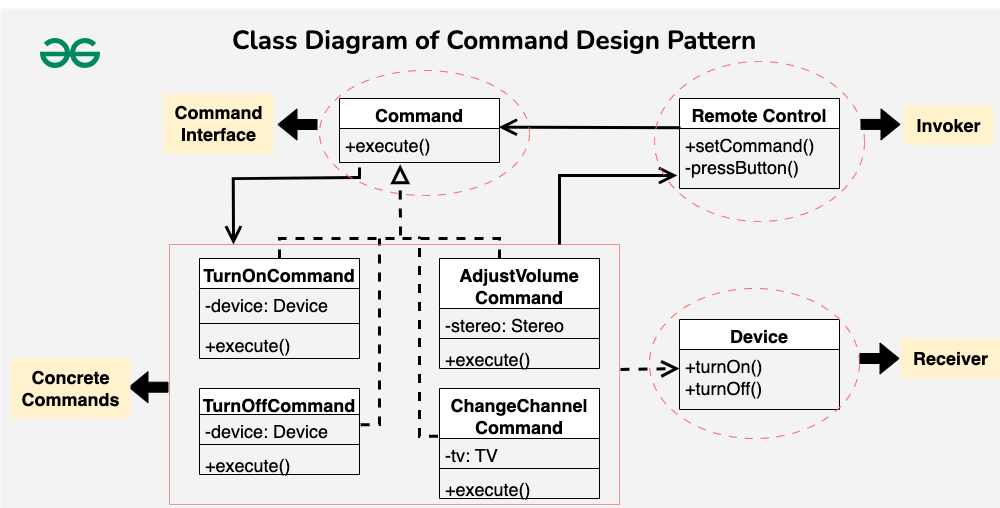
Command
Command encapsulates a request as an object, allowing for parameterization and queuing.
- Scenario: A Smart Home app. “Turn on lights” is wrapped in a Command object. This allows the app to queue the command, log it, or even undo it later.
Interpreter & Iterator
While Interpreter deals with grammar, Iterator provides a way to access elements of a collection sequentially without exposing the underlying representation.
- Scenario: A media player playlist. The iterator lets you press “Next” regardless of whether the playlist is a Linked List, an Array, or a Tree.
Mediator
Mediator restricts direct communications between objects and forces them to collaborate only via a mediator object.
- Scenario: An Air Traffic Control tower. Planes (Components) do not talk to each other to decide who lands first; they talk to the Tower (Mediator).
Memento
Memento captures and externalizes an object’s internal state so the object can be restored to this state later.
- Scenario: The “Save Game” feature. It saves the snapshot of the world without exposing the private variables of every game entity.
Observer
Observer defines a subscription mechanism to notify multiple objects about events.
- Scenario: A YouTube channel. When a creator uploads a video (Subject), all subscribers (Observers) get a notification.
State
State allows an object to alter its behavior when its internal state changes.
- Scenario: A vending machine. If the state is
NoCoin, pressing “Buy” asks for money. If the state isHasCoin, pressing “Buy” dispenses the item.
Strategy
Strategy defines a family of algorithms and makes them interchangeable.
- Scenario: A navigation app. You can choose a
FastestRouteStrategy,ScenicRouteStrategy, orFuelEfficientStrategy. The input (A to B) is the same, but the algorithm differs.
Template Method
This defines the skeleton of an algorithm in a superclass but lets subclasses override specific steps.
- Scenario: A
DataMinerclass. The stepsopenFile(),extractData(), andcloseFile()are defined. Subclasses likePdfMinerorCsvMineronly override theextractData()step.
Visitor & Acyclic Visitor
Visitor separates algorithms from the object structure on which they operate. While powerful, the standard implementation comes with a trade-off regarding system stability versus extensibility.
- Standard Visitor: This is ideal when your object structure (the classes) rarely changes, but you frequently define new operations on them.
- The Catch: It introduces a cyclic dependency. The
Visitorinterface must know about every concrete element type (e.g.,Visit(Book),Visit(Food)). Adding a new element class forces you to modify the interface and recompile every existing visitor, breaking the Open-Closed Principle.
- The Catch: It introduces a cyclic dependency. The
- Acyclic Visitor: This advanced variant breaks the dependency cycle, allowing you to add new element classes without affecting existing algorithms.
- How it works: Instead of a monolithic interface, it often uses dynamic type checking or multiple specific interfaces (e.g., checking
if (visitor is IBookVisitor)) to decouple the system.
- How it works: Instead of a monolithic interface, it often uses dynamic type checking or multiple specific interfaces (e.g., checking
- Scenario: A tax calculation system for an e-commerce platform.
- Standard: You have stable items like
BookandFood. You can easily add aHolidayTaxVisitororVATVisitor. However, if you add a new item type likeNFT, you break the entire visitor hierarchy. - Acyclic: You can introduce the
NFTclass and a correspondingNFTVisitorwithout touching the stable, existing tax logic for books and food.
- Standard: You have stable items like
- Traversal Strategies: Whether using standard or acyclic, remember that traversal logic can be handled by the elements themselves, the visitor, or an external iterator
| Feature | Standard Visitor | Acyclic Visitor |
|---|---|---|
| Dependencies | Cyclic: The Visitor must know every Element; Elements must know the Visitor. | Acyclic: The dependency cycle is broken. The Visitor interface is generic or degenerate (empty). |
| Interfaces | One giant interface with methods for every concrete element (e.g., visit(ElementA), visit(ElementB)). | Many tiny, specific interfaces, one for each element (e.g., VisitorForA, VisitorForB). |
| Dispatch Mechanism | Static Double Dispatch: The compiler guarantees the correct method is called. | Dynamic Cast / Reflection: The accept method uses dynamic_cast (or instanceof) to check if the visitor supports that specific element. |
| Type Safety | Compile-time safe: If you add an Element, you must update the Visitor interface, or the code won’t compile. | Runtime check: If a Visitor doesn’t implement the specific interface for an element, the operation simply fails or does nothing at runtime (no compile error). |
Choosing the Right Tool
It is crucial to understand the nuances between similar patterns:
- Facade vs. Mediator: A Facade abstracts a subsystem for a client, whereas a Mediator manages communication between system components.
- Strategy vs. State: Strategy allows you to swap algorithms (how something is done), while State is about changing behavior based on internal conditions (what state the object is in).
- Decorator vs. Proxy: Decorators add responsibilities; Proxies control access.
Mastering these patterns allows us to write code that is resilient to change and easier to understand—a necessity for any high-quality software architecture.
Source Acknowledgment: This post is based on my interpretation of the Design Patterns educational material by Dr. Simon Balázs, BME, IIT.