Object-Oriented Design Principles

You write a feature, it works perfectly, and you deploy it. Two months later, a simple requirement change comes in, and suddenly you’re rewriting half the application. Why? Because while the code worked, it wasn’t designed to handle change.
Here I will cover everything from the famous SOLID principles to high-level Package Architecture and practical rules like DRY and Tell, Don’t Ask. 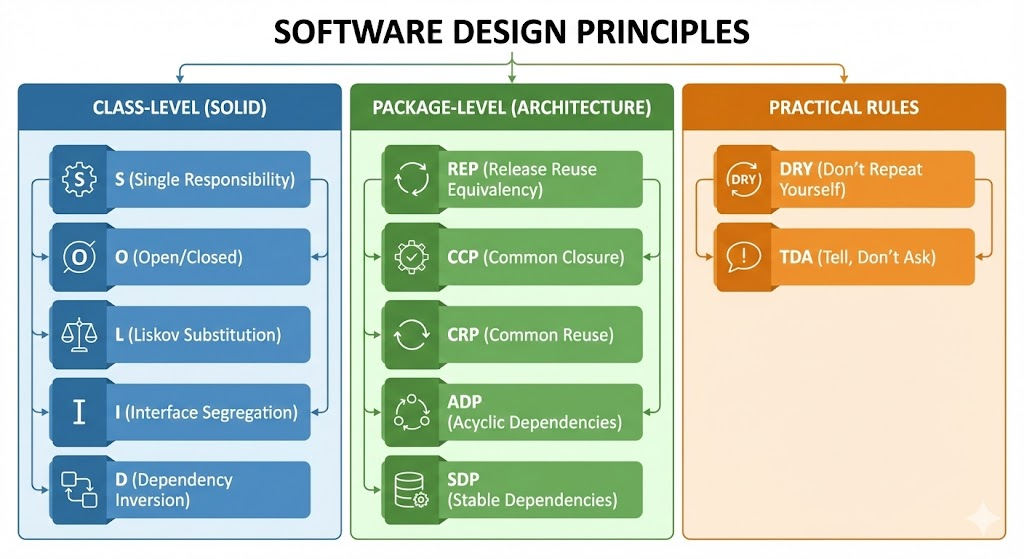
1. The SOLID Foundation
The resource heavily emphasizes the SOLID principles. These are the bread and butter of maintainable object-oriented programming.
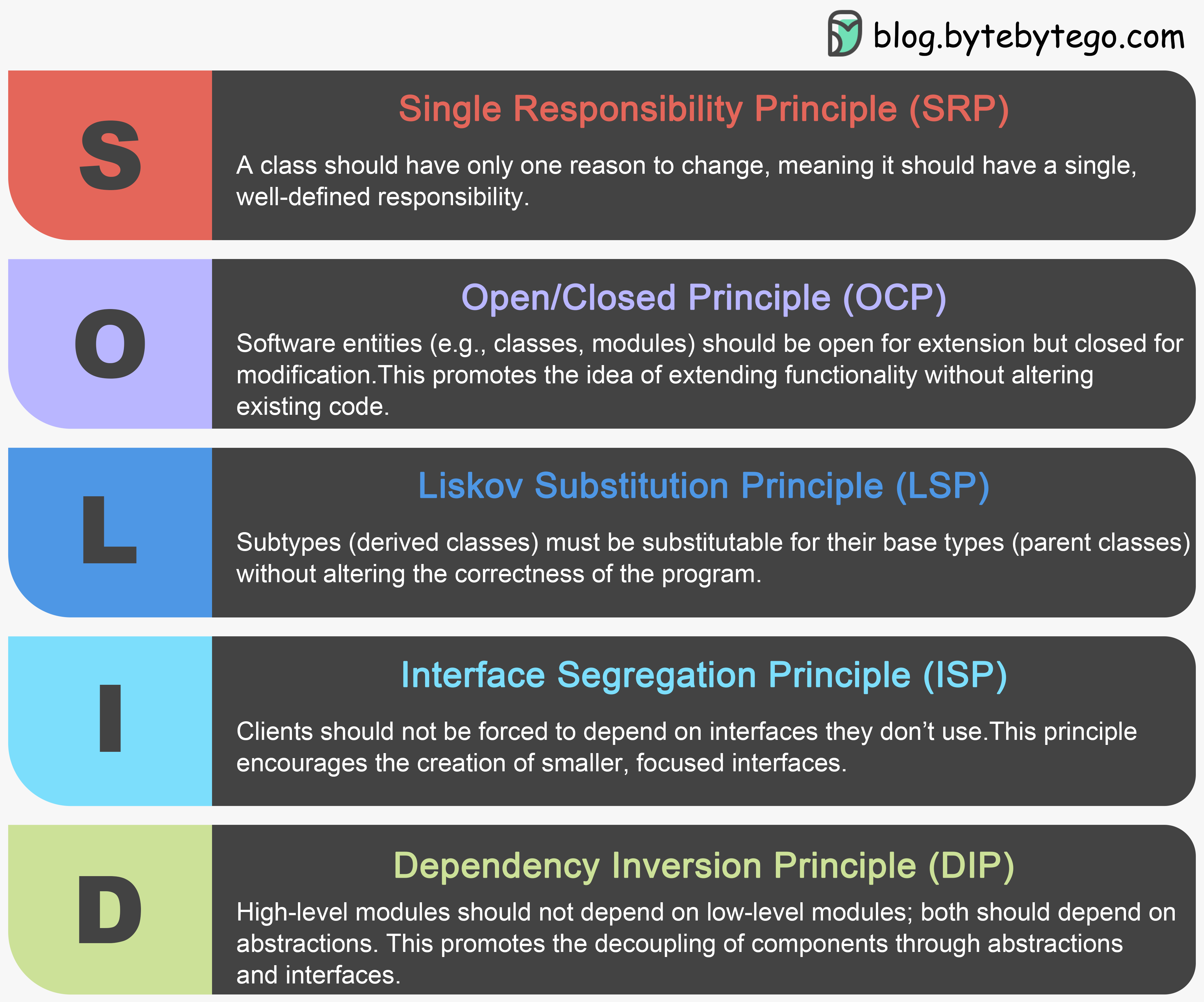
S - Single Responsibility Principle (SRP)
The Concept: A class should have one, and only one, reason to change. The Mistake: Mixing “business logic” with “infrastructure” (like logging or saving to a file). Better Example: Imagine an Order class that calculates total price and generates a PDF invoice. If you change the PDF library, you risk breaking the calculation logic.
1
2
3
4
5
6
7
8
9
10
11
12
13
14
// Bad: Two responsibilities
public class Order {
    public void CalculateTotal() { /* ... */ }
    public void GeneratePdfInvoice() { /* ... */ }
}

// Good: Split them up
public class Order {
    public double CalculateTotal() { /* ... */ }
}

public class InvoiceGenerator {
    public void GeneratePdf(Order order) { /* ... */ }
}
O - Open/Closed Principle (OCP)
The Concept: Software entities should be open for extension, but closed for modification. The Goal: Add new features by adding new code, not by changing old code. Better Example: You have a discount calculator. Instead of a giant if-else block that you have to modify every time a new seasonal sale starts, use polymorphism.
1
2
3
4
5
6
7
8
9
10
11
12
13
14
// The Abstraction
public interface IDiscountStrategy {
    double ApplyDiscount(double originalPrice);
}

// Extension 1: No change to existing code needed to add this!
public class BlackFridayDiscount : IDiscountStrategy {
    public double ApplyDiscount(double price) => price * 0.5;
}

// Extension 2
public class SeniorCitizenDiscount : IDiscountStrategy {
    public double ApplyDiscount(double price) => price * 0.8;
}
L - Liskov Substitution Principle (LSP)
The Concept: Subtypes must be substitutable for their base types. The Warning: Just because “A is a B” in English doesn’t mean “A inherits B” in code. Better Example: The classic “Ostrich problem.” If you have a Bird class with a Fly() method, and you inherit Ostrich from it, you are in trouble. If you override Fly() to throw an exception, you have violated LSP because the caller expected the bird to fly.
1
2
3
4
// Violation
public void MakeBirdFly(Bird bird) {
    bird.Fly(); // Crushes if bird is an Ostrich!
}
Solution: Separate the interfaces. Have a Bird class and an IFlyingBird interface.
I - Interface Segregation Principle (ISP)
The Concept: Clients should not be forced to depend on methods they do not use. The Mistake: Creating “God Interfaces” that do everything. Better Example: Imagine a MultiFunctionPrinter. If you have a simple interface IMachine, a basic printer shouldn’t be forced to implement Fax() or Scan().
1
2
3
4
5
6
7
8
9
10
11
12
13
// Bad
interface IMachine {
    void Print();
    void Scan(); // OldPrinter has to throw NotImplementedException here
    void Fax();
}

// Good: Segregate!
interface IPrinter { void Print(); }
interface IScanner { void Scan(); }

// Now OldPrinter only implements what it needs
class OldPrinter : IPrinter { ... }
D - Dependency Inversion Principle (DIP)
The Concept: High-level modules should not depend on low-level modules; both should depend on abstractions. The Practicality: Your business logic shouldn’t care if you are saving data to an SQL Database or a text file.
1
2
3
4
5
6
7
8
9
10
11
12
13
14
// Bad: High level (Notification) depends on Low level (GmailService)
class NotificationService {
    private GmailService _gmail = new GmailService(); // Hard dependency
}

// Good: Depend on Abstraction
class NotificationService {
    private IMessageSender _sender;

    // Inject the dependency
    public NotificationService(IMessageSender sender) {
        _sender = sender;
    }
}
2. Organizing the Architecture (Package Principles-REP,CCP,ADP)
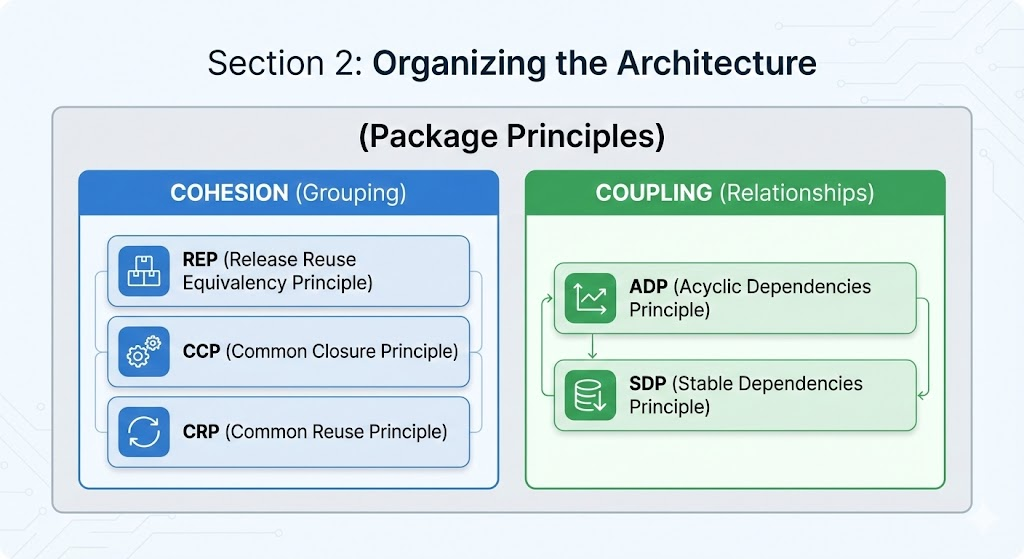
Here we discuss how we organize classes into packages or namespaces. This is often overlooked but crucial for large systems.
- The Release Reuse Equivalency Principle (REP): If you want to reuse code, it must be tracked, versioned, and released properly. You can’t just copy-paste files; you need packages (like NuGet or npm).
- The Common Closure Principle (CCP): “Classes that change together, belong together”. If changing a database schema requires you to update 5 different packages, your closure is bad. Group related concepts.
- Common Reuse Principle (CRP): Classes that aren’t reused together should not be grouped together
- The Acyclic Dependencies Principle (ADP): Avoid cycles in your dependency graph. If Package A depends on B, and B depends on C, and C depends on A you can never release them independently.
The Stable Dependencies Principle (SDP): “Depend in the direction of stability.” A module should depend only on modules that are more stable than itself. If a module is designed to be volatile (easy to change, like a UI widget), it should depend on stable modules (hard to change, like core business entities). Never let a stable module depend on a volatile one, or your “stable” code will break every time the volatile code changes.
3. Practical Hygiene: DRY and TDA
Finally, the resource touches on two “golden rules” of daily coding.
DRY (Don’t Repeat Yourself)
Every piece of knowledge must have a single representation.
- Correction: It’s not just about copy-pasting lines of code. It’s about duplicating logic. If you have a tax calculation logic repeated in the Frontend JS and the Backend C#, you are violating DRY.
Tell, Don’t Ask (TDA)
Don’t ask an object for its data and then do the work yourself. Tell the object to do the work.
1
2
3
4
5
6
7
// Bad: Asking for state and acting on it
if (wallet.Balance > amount) {
    wallet.Balance -= amount;
}

// Good: TDA (Encapsulation)
wallet.Debit(amount); // The wallet manages its own state logic
Summary
The difference between a junior and a senior developer is often the ability to spot where these principles are violated before the code is written. Whether it’s adhering to SOLID to ensure classes are manageable or following ADP to ensure your architecture doesn’t become a tangled web, these principles are your toolkit for longevity.
Source Acknowledgment:This post is based on my personal notes and interpretation of the “Object-Oriented Design Principles” lecture materials by Dr. Balázs Simon (BME, IIT).