Lab 02: Unprotected admin functionality with unpredictable URL

1. Executive Summary
Vulnerability: Unprotected Admin Functionality (Security by Obscurity).
Description: The application attempts to secure the admin panel by using a long, random, unpredictable URL (e.g., /admin-km2dj1) instead of proper access controls. However, this URL is disclosed in the client-side JavaScript.
Impact: Attackers can discover the hidden URL by inspecting the application’s source code and gain full administrative access without credentials.
2. The Attack
Objective: Access the admin panel and delete carlos.
- Reconnaissance: I reviewed the client-side code. I opened the browser Developer Tools (F12) and viewed the Page Source of the main landing page.
Discovery: Inside a
<script>block, I found JavaScript logic that constructs a link to the admin panel. The “secret” URL was hardcoded directly in the source:JavaScript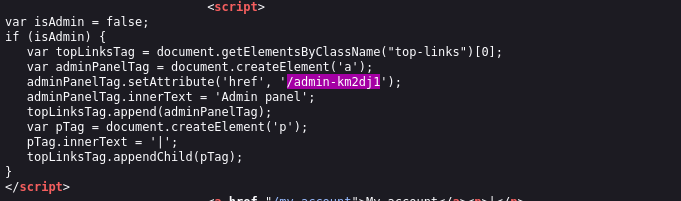
- Exploitation: I copied the path
/admin-km2dj1and pasted it into the address bar. Result: The application loaded the Admin Dashboard without asking for a login. I successfully deleted the user
carlos.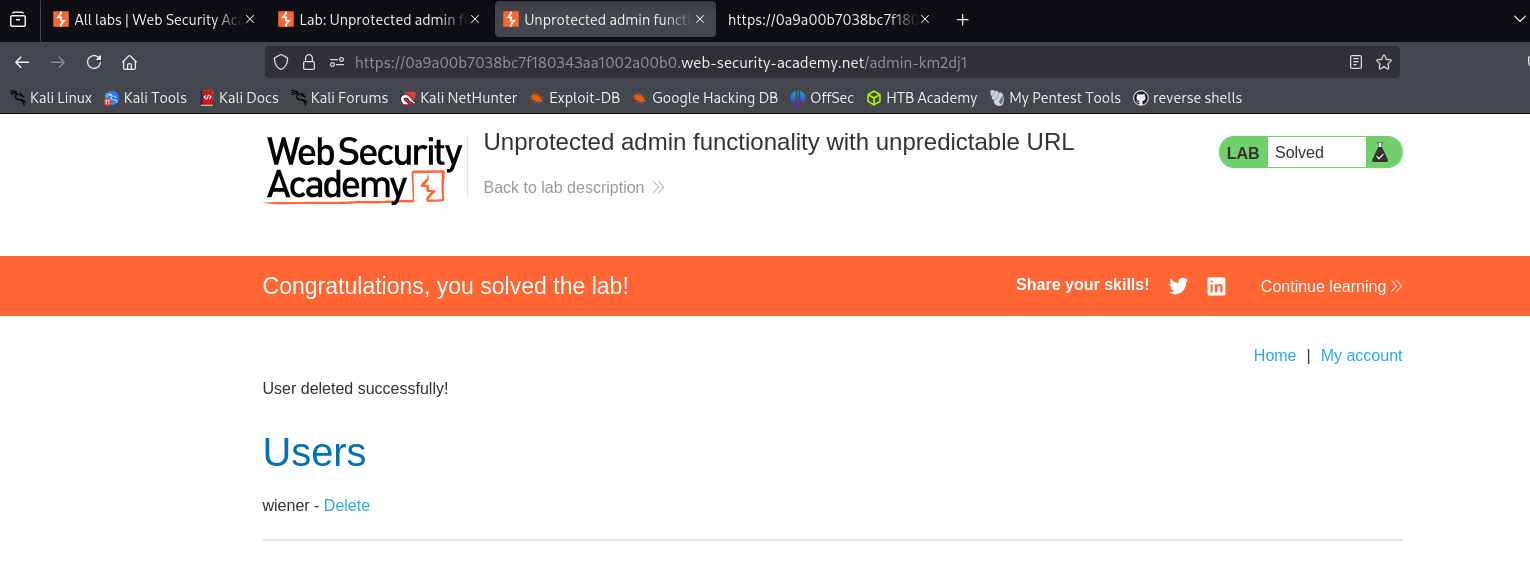
3. Code Review
Vulnerability Analysis (Explanation): In the examples below, the developer has mapped the Controller to a specific, obscure URL string. They are relying entirely on the assumption that an attacker cannot guess this string.
- The Flaw: The security model is tied to the secrecy of the path, not the identity of the user. Once the path is known (leaked in JS, logs, or browser history), the security is gone.
- The Reality: The method is public. The server executes it for any incoming request that matches the URL, regardless of whether the user is an admin or an anonymous visitor.
Java (Spring Boot)
1
2
3
4
5
6
7
8
9
10
11
@Controller
public class AdminController {

    // The developer relies on the randomness of "km2dj1" to hide the page.
    // There are no security annotations here.
    // If you know the URL, you are the admin.
    @GetMapping("/admin-km2dj1")
    public String adminPanel(Model model) {
        return "admin_dashboard";
    }
}
C# (ASP.NET Core)
1
2
3
4
5
6
7
8
9
10
11
public class AdminController : Controller
{
    // The Route matches the secret URL found in the JS.
    // Missing [Authorize] attribute means the Identity of the caller is ignored.
    [HttpGet]
    [Route("admin-km2dj1")]
    public IActionResult Index()
    {
        return View();
    }
}
Mock PR Comment
The endpoint /admin-km2dj1 lacks server-side authorization checks. Relying on an unpredictable URL string constitutes Security by Obscurity, which is insufficient as the URL is exposed in client-side assets. Implement role-based access control (RBAC) to verify that the requesting session belongs to an administrator.
4. The Fix
Explanation of the Fix: To secure this, we abandon the “secret URL” strategy. We can rename the path to something standard like /admin. The security is enforced by Middleware or Interceptors which intercept the request before it reaches the controller logic. They check the user’s session claims for the ADMIN role.
1
2
3
4
5
6
7
8
9
10
11
@Controller
public class AdminController {

    // SECURE: We use a standard URL.
    // @PreAuthorize checks the SecurityContext for the 'ADMIN' authority.
    @PreAuthorize("hasRole('ADMIN')")
    @GetMapping("/admin")
    public String adminPanel(Model model) {
        return "admin_dashboard";
    }
}
C# (ASP.NET Core)
1
2
3
4
5
6
7
8
9
10
11
12
// SECURE: The [Authorize] attribute acts as a gatekeeper.
// If the user's claims do not include Role="Admin", the server returns 403 Forbidden.
[Authorize(Roles = "Admin")]
public class AdminController : Controller
{
    [HttpGet]
    [Route("admin")]
    public IActionResult Index()
    {
        return View();
    }
}
5. Automation
A Python script to scrape a webpage and use Regex to look for “hidden” or interesting paths inside JavaScript variables or href attributes.
1
2
3
4
5
6
7
8
9
10
11
12
13
14
15
16
17
18
19
20
21
22
23
24
25
26
27
28
29
30
31
32
33
34
import requests
import re

def find_hidden_admin_panel(base_url):
	print(f"[*] Scanning {base_url} for hidden links...")

	try:
		response = requests.get(base_url);
		if response.status_code != 200:
			print("[-] Could not load page.")
			return
		pattern = re.compile(r"['\"](/admin[a-zA-Z0-9-]+)['\"]") #match admin panel pattern
		matches = pattern.findall(response.text) #find this pattern in response html file
		if not matches:
			print("[-] No suspicious admin paths found in the source code")
			return

		for match in matches:
			print("[!!!] Found potential hidden path in Source:{match}")

			full_url = base_url + match
			print("[*] Veryfying access to: {full_url}")
			check = requests.get(full_url)

			if check.status_code == 200:
				print(f"  -> CONFIRMED: {full_url} is accessible (200 OK)!")
			else:
				print(f"  -> Path returned {check.status_code}")

	except Exception as e:
	print(f"Error:{e}")

# Usage
# find_hidden_admin_panel("https://LAB-ID.web-security-academy.net")