Textual Modeling for Security Pros
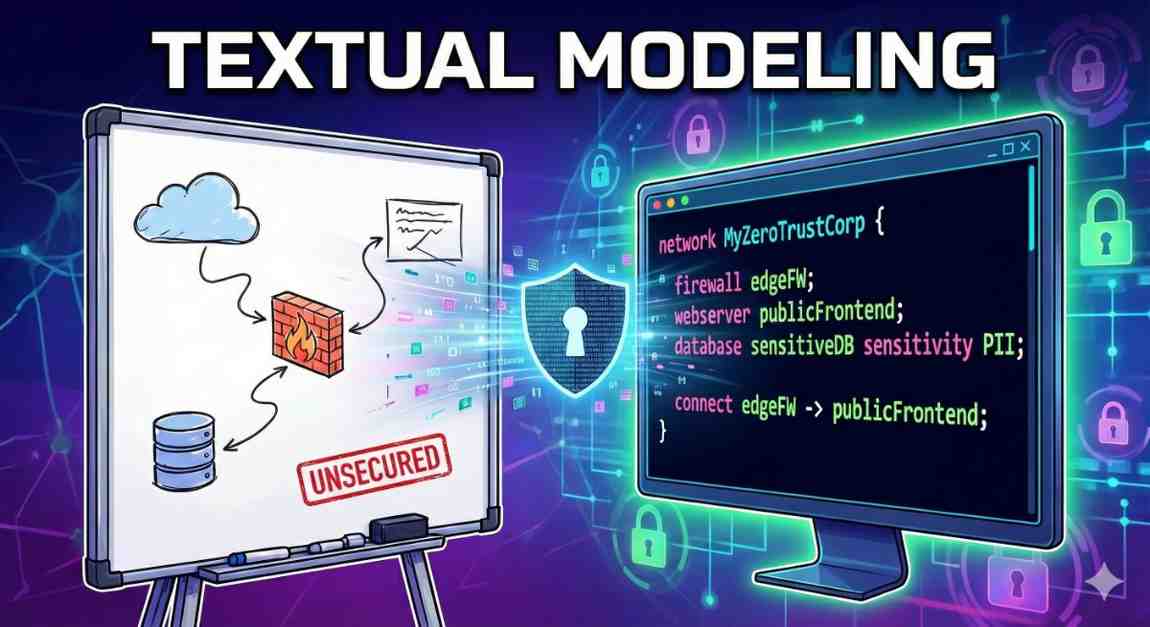
If you’ve followed my posts on penetration testing and app sec, you know the struggle of architectural diagrams. You draw a “Secure Network” on a whiteboard or in Visio: a Firewall here, a Database there, and a line showing traffic flow.
But to a computer, that Visio diagram is just pixels. It doesn’t know that a Database shouldn’t connect directly to the Internet.
In Model-Driven Engineering (MDE), we fix this by moving from drawing pictures to defining languages. Today, I’m going to show you how to build a Domain Specific Language (DSL) to model a secure network.
We will cover Grammars, Parser Rules, Terminals, and Cross-References.
The Goal: “NetworkDSL”
We want to create a language that lets us define a corporate network like this:
1
2
3
4
5
6
7
8
9
10
network MyZeroTrustCorp {
    // Define our assets
    firewall edgeFW
    webserver publicFrontend
    database sensitiveDB sensitivity PII

    // Define allowed traffic (The rules)
    connect edgeFW -> publicFrontend
    connect publicFrontend -> sensitiveDB
To make this work, we need to write a Grammar. In frameworks like Langium or Xtext, the grammar is the DNA of your language. It defines valid syntax and simultaneously generates the code structure (AST) to hold the data.
Let’s break it down, line by line.
1. The Container (The Entry Point)
Every textual model needs a root. In our case, it’s the Network.
1
2
3
4
5
6
7
8
9
10
11
grammar NetworkDSL

entry Model:
    (tags += SensitiveTag | networks += Network)*;

SensitiveTag: "tag" name=ID;

Network:
    "network" name=ID "{"
        (assets += Asset)* (connections += Connection)*
    "}";
The Concepts:
grammar: Defines the name of your language.entry: Tells the parser “Start reading here.”+=(Assignment): This is crucial. It tells the parser to take whatever it finds and add it to a list.assets += Assetmeans “The Network object has a list calledassets.”*(Cardinality): Means “Zero or more”. You can have a network with 100 assets or 0 assets.{ }: they are just characters we force the user to type to organize their code blocks.
2. The Nodes (Polymorphism in Text)
In a diagram, you drag a “Firewall” shape or a “Database” shape. In text, we define these as Parser Rules.
1
2
3
4
5
6
7
8
// The Abstract Rule
Asset: WebServer | Database | Firewall;

// The Concrete Rules
WebServer: "webserver" name=ID;
Firewall:  "firewall"  name=ID;

Database:  "database"  name=ID ("sensitivity" sensitivity=[SensitiveTag])?;
TheConcepts:
- Dispatch Rules (
|): TheAssetrule doesn’t have its own keywords. It creates a “Union Type” (or inheritance). It says: “An Asset is either a WebServer OR a Database OR a Firewall.” - Optional Groups (
?): Look at the Database. The(...)?means the sensitivity part is optional. You can define a DB without tagging it as sensitive. - Attributes (
name=ID): We are capturing the identifier the user types (e.g., “usersDB”) and saving it in thenameproperty.
3. The Edges (Cross-References)
This is the most powerful part of MDE. How do we draw a line between two text definitions? We use Cross-References.
1
2
Connection:
    "connect" from=[Asset] "->" to=[Asset];
The Concepts:
[...](Square Brackets): This syntax creates a Reference, not a definition.- How it works: When the parser sees
from=[Asset], it pauses. It looks at the text inside the brackets (e.g., “edgeFW”), searches the rest of the file for an Asset defined with that name, and links them in memory. - Why it matters: If you type
connect nonExistentServer -> DB, the editor gives you an error automatically. You get “Spell check” for your architecture.
4. The Building Blocks (Terminals)
Finally, how does the parser know what an “ID” is? We define Terminals (Regex rules).
1
2
3
4
5
6
7
8
// "hidden" means we skip whitespace automatically
hidden terminal WS: /\s+/;

// ID starts with a letter, followed by letters or numbers
terminal ID: /[_a-zA-Z][\w_]*/;

// INT returns a number, not a string
terminal INT returns number: /[0-9]+/;
5. Final State of the Model
1
2
3
4
5
6
7
8
9
10
11
12
13
14
15
16
17
18
19
20
21
22
23
24
25
26
27
28
29
30
31
32
grammar NetworkDSL

entry Model:
    (tags += SensitiveTag | networks += Network)*;

SensitiveTag: "tag" name=ID;

Network:
    "network" name=ID "{"
        (assets += Asset)* (connections += Connection)*
    "}";

// The Abstract Rule
Asset: WebServer | Database | Firewall;

// The Concrete Rules
WebServer: "webserver" name=ID;
Firewall:  "firewall"  name=ID;

Database:  "database"  name=ID ("sensitivity" sensitivity=[SensitiveTag])?;

Connection:
    "connect" from=[Asset] "->" to=[Asset];

// "hidden" means we skip whitespace automatically
hidden terminal WS: /\s+/;

// ID starts with a letter, followed by letters or numbers
terminal ID: /[_a-zA-Z][\w_]*/;

// INT returns a number, not a string
terminal INT returns number: /[0-9]+/;
With the following model:
1
2
3
4
5
6
7
8
9
10
11
12
13
14
tag PII
tag PCI

network MyZeroTrustCorp {

    firewall edgeFW
    webserver publicFrontend
    database sensitiveDB sensitivity PII
    database logsDB

    connect edgeFW -> publicFrontend
    connect publicFrontend -> sensitiveDB
    connect publicFrontend -> logsDB
}
Final State of the Grammer can be seen here: Langium
Why This Matters for Security
Why go through this trouble instead of just writing a Python script or drawing a diagram?
1. Impossible States: In a drawing tool, I can draw a line from the “Internet” straight to my “Secret Database.” In my Grammar, I can write a Validation Rule (a simple TypeScript function) that says:
Error: A generic Asset cannot connect to a Database with sensitivity PII unless it is a WebServer.
2. Code Generation: Once I have this text model, I can write a generator that reads my secure network design and automatically outputs Terraform code or Firewall Rules (iptables).
Summary Cheat Sheet
| Concept | Syntax | Meaning |
|---|---|---|
| Assignment | property = Rule | “Consume the next token and store it here.” |
| List Add | list += Rule | “Add the next item to this array.” |
| Reference | ref = [Type] | “Find an existing object with this name; don’t create a new one.” |
| Cardinality | *, +, ? | Zero-or-more, One-or-more, Optional. |
| Terminal | terminal NAME: /regex/ | How to read raw characters (Words, Numbers). |